
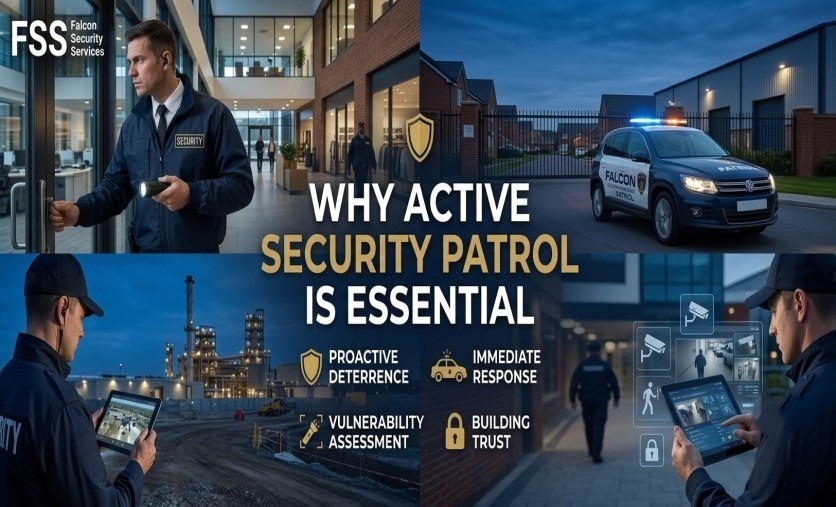
A security guard patrol is a scheduled or randomised tour of your property by a licensed officer who checks entry points, vulnerable areas and equipment, then documents what they found. Unlike a camera, a patrol can open a door, challenge a trespasser and write the report your insurer will ask for.
The question most property owners should be asking is not whether patrols work. It is whether the patrols you are paying for are actually happening, and whether you can prove it. This guide covers both.
What a security guard patrol actually is
A patrol differs from a static guard post in one respect: movement. A static officer holds a position. A patrol officer moves through a route, covering ground a fixed post never sees.
That movement is the value. It removes blind spots, it makes the officer’s arrival unpredictable, and it produces a record of the property’s condition at a point in time. Our mobile patrol services run on this model across Ontario and British Columbia
What a patrol covers on a typical tour
A properly specified security patrol is a checklist, not a walk. On a standard tour an officer will:
- Check perimeter fencing, gates and lighting for damage or gaps
- Test that exterior doors, loading bays and gates are secured
- Inspect parking areas and stairwells for loitering or vehicle interference
- Verify fire exits are clear and alarm panels show no faults
- Note equipment, materials or vehicles that have moved or gone missing
- Challenge and log anyone on site without authorisation
- Record the tour with timestamps and any exceptions found
If your current provider cannot show you this list as a written scope, you do not have a patrol specification. You have an informal arrangement.
Foot, vehicle and mobile patrols: which fits your property
The format follows the footprint.
Foot patrols suit compact, detail-heavy sites where the officer needs to look closely: office floors, retail interiors, lobbies and small commercial buildings.
Vehicle patrols suit large or dispersed footprints where ground has to be covered fast: industrial sites, yards, parking structures and gated communities.
Mobile patrols combine both and add multi-site coverage, with one officer rotating across several properties on a schedule. This is usually the most cost-effective option for properties that need presence rather than constant occupation.
We break the trade-offs down in detail in our foot patrols versus vehicle patrols comparison and our guide to daily, nightly and on-demand patrol schedules.
How to verify a patrol actually happened
This is where most patrol contracts quietly fail, and it is the part nobody sells you on.
Checkpoint scans
Serious providers install NFC tags or QR checkpoints at fixed locations on the route. The officer scans each one, which timestamps and geotags their presence. If a checkpoint was missed, the report shows it. Ask how many checkpoints your route has and where they sit — a route with three checkpoints on a twelve-acre site proves very little.
Patrol reports
Every tour should generate a report you receive, not one filed internally. It should carry the officer’s name, start and end times, checkpoint completion, and a plain description of anything found. Photographs of damage or hazards should be attached.
Exception reporting
Routine reports get skimmed. Exception reporting flags only what deviated — a missed checkpoint, an unsecured door, an incident — so the things that need your attention surface immediately instead of being buried in a clean log.
Route randomisation
A patrol that arrives at the same gate at the same minute every night trains anyone watching. Ask whether your route timing varies, and how that variation is still audited.
How often should patrols run
Frequency should follow risk, not budget convenience. Properties with valuable plant and no overnight occupancy usually need multiple nightly tours. Occupied residential and commercial buildings often need fewer tours but longer ones, with attention to shared spaces.
The honest answer is that frequency is set by a site assessment, not a price list. Two thorough tours often beat five rushed ones, and a provider who quotes frequency before seeing the site is quoting a template.
Which properties get the most from security patrols
Patrol coverage delivers most where the property is valuable, exposed and empty for long stretches:
- Construction sites, where materials, copper and equipment sit unattended overnight. Our construction site security services are built around this pattern.
- Warehouses and distribution centres, where perimeter and loading-dock exposure is the primary risk. See warehouse security.
- Industrial yards, where metal theft and after-hours trespass are persistent.
- Residential complexes, where parking levels and shared amenities need presence without a permanent desk. See residential security.
- Retail parks and commercial plazas, where closing-time and overnight vulnerability peaks.
Security patrols, cameras and static guards
Cameras record. Patrols intervene. A camera tells you what happened after the fact; a patrolling officer can stop it while it is happening and document the scene properly for a claim.
Static guards and patrols solve different problems. A static post controls a specific point continuously. A patrol covers many points intermittently. Most properties need one or the other, and a few need both at different hours. Our comparisons of mobile patrol versus static guarding and why patrols outperform CCTV alone go deeper on both.
If you are weighing coverage formats for a larger site, our breakdown of static, mobile and robotic coverage models lays out the options side by side.
What to ask before hiring a patrol provider
- Are all officers licensed for the province the site sits in?
- What does the written patrol scope include, and who signs off on it?
- How many checkpoints are on the route, and what technology records them?
- Will I receive a report after every tour, or a monthly summary?
- Who supervises the officers, and how often are spot checks run?
- What is the escalation path at 3am, and who answers?
- How is patrol timing randomised while still being auditable?
Our guide on what to check before signing a security guard contract covers the commercial terms that sit alongside these operational questions.
Book a site assessment and we will specify a patrol route, frequency and reporting standard for your property.
Frequently asked questions
1. What is a security guard patrol?
Ans. A security guard patrol is a licensed officer moving through a defined route on your property to check entry points, deter intruders, identify hazards and document conditions. Patrols can be conducted on foot, by vehicle, or as multi-site mobile patrols.
2. How is a security patrol different from a static guard?
Ans. A static guard holds one position continuously. A patrol officer covers multiple areas on a route, which removes blind spots but means no single point is watched constantly.
3. How do I know the security patrol actually took place?
Ans. Through checkpoint scanning and per-tour reporting. NFC or QR checkpoints timestamp the officer’s presence at fixed locations, and the resulting report shows which checkpoints were completed and what was found.
4. How often should security patrols be scheduled?
Ans. Frequency depends on occupancy, asset value and incident history. High-value unoccupied sites usually need multiple nightly tours; occupied buildings often need fewer but longer ones. A site assessment should set this, not a standard package.
5. Are security guard patrols cost-effective compared to a full-time guard?
Ans. For most properties, yes. A patrol delivers presence and documentation across the highest-risk hours without funding continuous occupation of a single post.
6. Can patrol officers respond to alarms and emergencies?
Ans. Yes. Licensed officers can respond to alarm activations, secure the area, contact emergency services and document the incident. Confirm response times and the escalation path with your provider before signing.
7. What technology is used in modern security patrols?
Ans. Checkpoint scanning through NFC or QR tags, GPS-tracked vehicle routes, incident reporting software with photo attachments, and in some cases aerial drone support for large perimeters.
8. Do security patrols work alongside CCTV?
Ans. They work best together. Cameras give continuous coverage and evidence; patrols give physical intervention and a documented inspection of what the cameras cannot see.