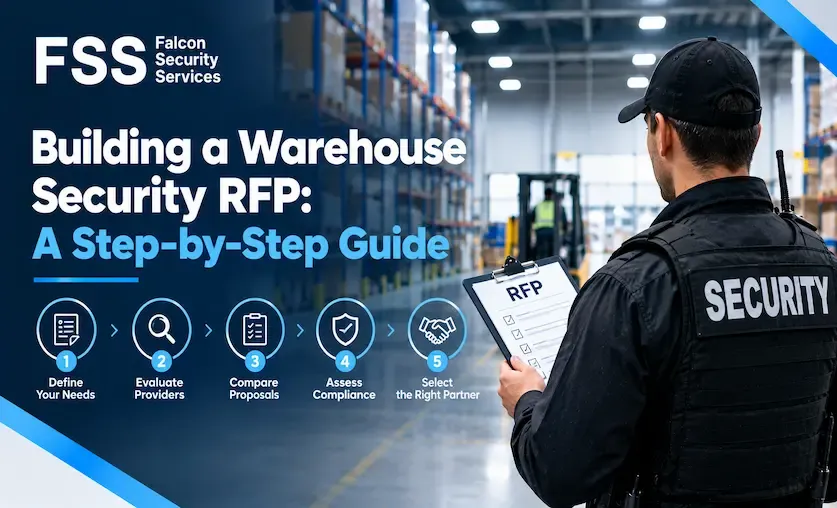
A warehouse security RFP is your one real chance to filter out providers who can’t actually protect a distribution operation — before they’re standing at your dock. Most templates ask for a headcount and a rate, which is precisely how operators end up with coverage that looks adequate on paper and misses the hours where loss actually happens. A well-built RFP tests whether a provider understands dock supervision, seal control, driver verification, yard risk, and what to do at 2 a.m. when nobody from your team is on site. This guide walks through how to scope, question, and evaluate. For the standard to hold providers to, see our warehouse security services.
Step 1: Scope by hours and by risk, not by headcount
Define what you’re buying before you ask anyone to price it. For each site, specify the posts, the hours, and the coverage model — and ground it in where your risk actually sits.
That means splitting the day as our coverage models guide sets out: operating hours (dock supervision, driver and visitor control), after hours (yard, perimeter, trailers), and continuous operations if you run them. A scope that says “provide security services” invites incomparable bids built on assumptions each provider invented. A scope that specifies “dock supervision 06:00–18:00, mobile patrol with minimum X yard checks overnight at varied times, checkpoint-logged” forces every bidder to answer the same question.
For multi-site operators, scope each location individually against a common framework so bids are comparable site to site. Resist the temptation to average your network into a single generic requirement — your busiest cross-dock and your quiet regional depot have genuinely different needs, and a blended scope guarantees you overpay at one and under-protect the other.
It’s also worth stating your desired outcomes alongside the scope. Telling bidders what you’re trying to achieve — eliminate unverified pickups, cut unexplained shrink, get auditable patrol evidence for clients — lets a capable provider propose something smarter than the staffing table you drafted. The scope sets the floor; the outcomes invite expertise.
Step 2: Ask the questions a generalist can’t answer
Weak RFPs ask about price. Strong ones demand evidence on what matters in distribution:
- Licensing. Is every officer licensed for the province each site sits in, and how is that verified continuously? Licensing is provincial, so a national network needs this confirmed everywhere.
- Warehouse experience. Which comparable distribution, 3PL, or fulfillment sites have they covered, and what incidents have they handled? Be wary of a pivot to retail or condo experience.
- Dock competence. How do officers verify drivers and bookings, handle seal control, and supervise loading? This is the sharpest filter in the whole RFP.
- Fraudulent pickup. What is their procedure when a driver’s paperwork doesn’t match your scheduling records? A provider without a clear answer hasn’t met the problem.
- Fill rates and turnover. Real numbers, plus how they cover a last-minute callout. An unstaffed dock is an unsupervised dock.
- Patrol verification. Time-stamped, checkpoint-based logs, and whether you get direct access to the data or must request it.
- Reporting and KPIs. What service levels will they commit to in writing, with what consequences for misses?
- Technology integration. How do they work with your cameras, access control, and yard management systems?
- Insurance. Coverage appropriate to a distribution environment, evidenced by certificate rather than promised.
The rule throughout: demand evidence, not adjectives. Capable providers answer with numbers, records, and references.
Building your RFP now? Book a consultation and we’ll help you pressure-test it.
Step 3: Set evaluation criteria before the bids arrive
Decide how you’ll score before you read anything, so a polished proposal doesn’t do the deciding for you. Weight toward reliability, dock competence, licensing, training, and references rather than rate alone.
In distribution, quality should carry real weight, because the cost of a weak provider — unsupervised docks, rising shrink, a fraudulent pickup, an unrecoverable trailer — dwarfs a modest difference in hourly cost. Build a simple scorecard, involve operations and loss prevention alongside procurement, and apply it consistently to every bid.
Be deliberate about a suspiciously low bid. It almost always means something has been removed: supervision, training hours, or the wage that keeps experienced officers from leaving. You’ll meet that saving again later as turnover and unfilled shifts.
Step 4: Verify, then contract
The proposal is a sales document; verification is the truth.
Call references at comparable warehouse sites and ask what went wrong during the relationship and how the provider handled it — every provider has had a bad shift, and the ones worth hiring are candid about it. Meet the supervisor who will actually run your account, not just the pitch team. Check licensing and insurance claims rather than accepting them. And pressure-test the onboarding plan, because a new provider arriving without site-specific post orders and induction produces exactly the gap you ran the RFP to avoid.
Then make sure everything you agreed lands in writing — our multi-site contract guide covers the structure for networks, and the weaknesses a sharp RFP surfaces are the same signs of an underperforming vendor you never want to discover after signing.
Frequently Asked Questions
- Q1. What should a warehouse security RFP include?
Ans. A scope defined by hours and risk per site, evidence-based questions on licensing, dock competence, fill rates, reporting and insurance, clear evaluation criteria, and a verification step before awarding.Q2. How do I scope security without knowing how many guards I need?
Ans. Scope by risk window rather than headcount — dock supervision during operating hours, yard and perimeter after close — and let providers propose the staffing that delivers it.Q3. What’s the most revealing question to ask?
Ans. How officers verify drivers and bookings and handle seal control. A provider who can’t describe that in detail hasn’t run a serious distribution site.Q4. Who should evaluate the bids?
Ans. Operations and loss prevention alongside procurement. The people who work beside security daily catch issues a purely commercial review misses.Q5. Should price or quality carry more weight?
Ans. Quality, in most distribution operations. A single fraudulent pickup or unrecoverable trailer can exceed years of the difference between bids.Q6. Why do fill rates matter so much?
Ans. Because an unstaffed post means an unsupervised dock or yard. A provider that can’t reliably staff your sites has a structural problem, not a temporary one.Q7. How do I compare bids that include different things?
Ans. Standardize the scope so every bid answers identical requirements, then compare what drives each price rather than the headline rate.Q8. Should we check references?
Ans. Yes, at comparable warehouse sites, and ask specifically what went wrong and how it was handled. Candour is a better signal than a flawless account.Q9. How long should the RFP process take?
Ans. Long enough for proper evaluation, reference checks, and a structured onboarding. Rushing it is how operators end up repeating the exercise within a year.Q10. What happens after we award?
Ans. Site-specific onboarding — post orders, induction, licensing verified before the first shift — followed by regular performance reviews against the KPIs you agreed.A warehouse security RFP done properly filters out providers who can’t run a dock before they’re hired to run yours. Scope by hours and risk, demand evidence over adjectives, score against what protects your operation, and verify before you sign.
- Ready to build an RFP that protects your sites? Request a consultation with our warehouse team.