The hardest thing about securing an industrial site is simple arithmetic: the perimeter is enormous and the number of people watching it is small. Industrial perimeter security using drones, K-9 patrol, and fixed coverage exists to solve that mismatch — each method covering ground the others can’t. A camera sees one angle forever, a drone sweeps kilometres of fence line in minutes, a K-9 team detects what no lens will, and a static officer holds the gate where people and vehicles actually enter. This guide explains what each layer genuinely does, its limits, and how to combine them. For the wider picture, see our industrial security services.
Why industrial perimeters defeat conventional security
A retail store has one door and a few aisles. An industrial site may have kilometres of fence, several gates, rail spurs, laydown yards, tank farms, and large gaps between buildings — much of it unlit and unobserved for most of the day.
That creates three problems conventional coverage handles badly. Distance: walking or driving the full perimeter takes so long that any single patrol leaves most of it unwatched at any moment. Blind spots: stacked material, trailers, and structures create cover that fixed cameras never see behind. Time: by the time a breach is noticed on a recording, the loss has already happened. Layering exists to close all three.
Fixed coverage: the foundation
Fixed coverage is everything that stays put — fencing, gates, lighting, access control, and camera systems, plus the static officers who hold key points.
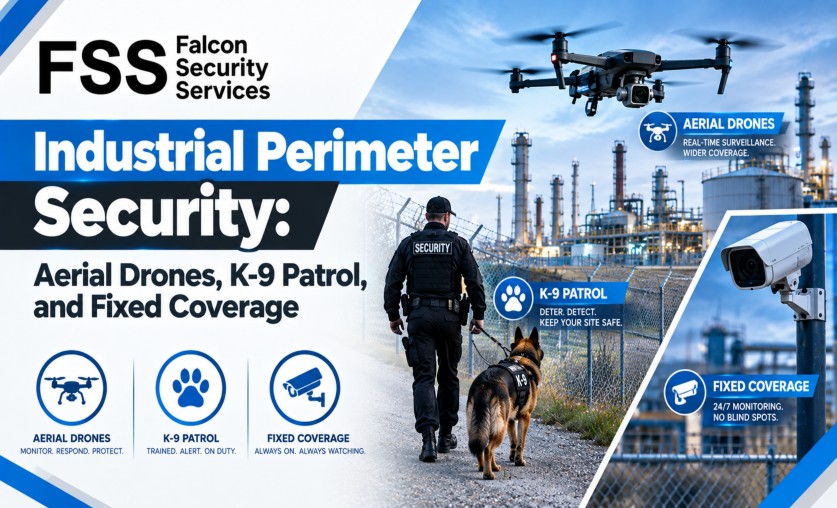
Its strength is consistency and control. A gatehouse post manages the one thing every legitimate visitor must do — enter through a controlled point — with access logging, contractor checks, and vehicle screening. Cameras provide persistent viewing of chosen angles and the evidence trail afterwards.
Its limits are equally clear: fixed assets only see where they’re pointed, and cameras that nobody watches live document incidents rather than preventing them. Fixed coverage is the necessary base layer, not a complete answer on a large site.
Aerial drones: covering distance fast
Drones solve the distance problem directly. An aerial drone can sweep a long fence line, a roof, a tank farm, or a laydown yard in a fraction of the time a vehicle or foot patrol would take, and it sees over and behind the obstructions that block ground-level views.
That makes them particularly useful for wide perimeter sweeps on large footprints, checking areas that are slow or unsafe to reach on foot, verifying an alarm quickly before committing people to a response, and adding an unpredictable overhead element that’s hard to plan around.
The practical caveats matter too. Drone operations in Canada are governed by Transport Canada’s rules for remotely piloted aircraft, including pilot certification and operating requirements, so this is a capability that must be run by a properly qualified provider — not improvised. Weather and flight duration also shape what’s realistic on a given night. Used well, drones extend your reach; they don’t replace people on the ground.
Wondering which layers your site actually needs? Book a consultation and we’ll map your perimeter with you.
K-9 patrol: detection and deterrence cameras can’t match
A K-9 patrol team brings something no technology replicates: detection capability across open ground plus a deterrent presence that is immediately understood.
Dogs work well in exactly the conditions that defeat cameras — darkness, large open yards, stacked material, and areas where a person could hide within metres of a lens without being seen. The deterrent effect is significant, and detection capability adds value at sites where searching ground quickly matters.
K-9 is a specialized, handler-dependent service, so it suits defined patrol windows and higher-risk sites rather than blanket, round-the-clock use. It’s a targeted layer, deployed where open ground and real intrusion risk justify it.
Robotic patrol and how the layers fit together
Robotic security adds a fourth option: consistent, repeatable patrol of defined routes without fatigue, which suits the long quiet hours where human attention naturally dips.
The way to combine them is to match each layer to the problem it solves:
- Fixed coverage at the points everyone must pass and the angles that must always be watched.
- Mobile patrol for ground presence, varied timing, and physical response.
- Drones for speed across distance and rapid alarm verification.
- K-9 for detection and deterrence in open yards during high-risk windows.
- Robotics for repeatable, consistent route coverage overnight.
None of it works without the connective tissue: someone monitoring in real time, a defined response for every detection, and documentation afterwards. Choosing the right mix starts with a proper industrial site risk assessment and is covered in depth in our guide to coverage models — with the overnight window, as always, being where perimeter risk concentrates.
Frequently Asked Questions
Q1. Why isn’t fencing and cameras enough for an industrial perimeter?
Ans. Because fixed assets only cover where they’re pointed, and large sites have long fence lines and blind spots behind stacked material and structures. Layering adds the movement and detection that fixed coverage lacks.
Q2. What do security drones actually do on an industrial site?
Ans. They sweep long perimeters, roofs, and yards far faster than ground patrols, see over obstructions, and can verify an alarm quickly before people are committed to a response.
Q3. Are security drones legal in Canada?
Ans. Yes, when operated under Transport Canada’s rules for remotely piloted aircraft, which include pilot certification and operating requirements. It’s a capability that requires a properly qualified provider.
Q4. Can drones replace security guards?
Ans. No. Drones extend reach and speed detection, but responding, controlling access, and dealing with people on the ground still require officers.
Q5. What does a K-9 patrol add that cameras don’t?
Ans. Detection capability across open ground and darkness, plus a strong deterrent presence — covering exactly the conditions where fixed cameras perform worst.
Q6. Is K-9 patrol suitable for round-the-clock coverage?
Ans. It’s usually deployed in defined patrol windows and at higher-risk sites rather than continuously, because it’s a specialized, handler-dependent service.
Q7. Where does robotic security fit?
Ans. It provides consistent, repeatable patrol of set routes without fatigue, which suits long overnight hours where human attention naturally declines.
Q8. How many layers does our site need?
Ans. It depends on your footprint, risk, and operating pattern. A risk assessment identifies your gaps, and the layers should be chosen to close those specific gaps rather than bought as a package.
Q9. Do these technologies work in Canadian winter conditions?
Ans. Weather affects all outdoor coverage — drones have flight limits in wind and precipitation, and ground conditions affect patrols. A good plan accounts for this rather than relying on one method alone.
Q10. What’s the most common perimeter security mistake?
Ans. Buying technology without a response behind it. Detection only matters if someone is watching in real time and can act on what’s found.
A large industrial perimeter can’t be secured by one method. Fixed coverage holds the points that matter, drones cover distance at speed, K-9 detects what lenses miss, robotics keep the quiet hours consistent, and officers respond. Combine them against your actual gaps and the perimeter stops being an unwatched liability.
Ready to design a layered perimeter for your site? Request a consultation with our industrial team.