
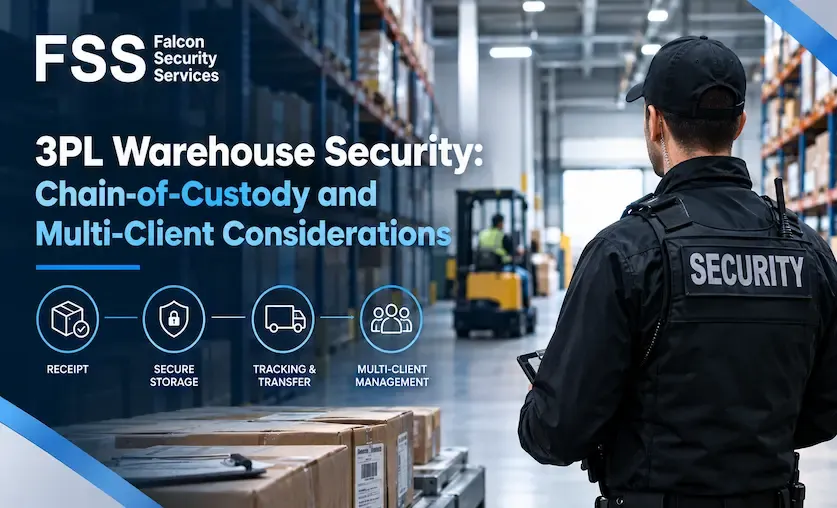
A third-party logistics operator carries a security problem that dedicated warehouses never face: you’re protecting other people’s inventory, for several clients at once, under one roof — and each of those clients holds you contractually accountable for it. 3PL warehouse security therefore isn’t just theft prevention. It’s demonstrable chain of custody, client separation, access control granular enough to survive an audit, and documentation good enough to settle a dispute about whose pallets went missing. This guide covers what makes 3PL security structurally different and what a capable operation looks like. For the wider picture, see our warehouse security services.
What makes 3PL security structurally different
In a dedicated warehouse, a loss is your loss. In a 3PL, a loss is someone else’s goods, your liability, and a potential contract-ending event. Four differences flow from that:
- Custody rather than ownership. You’re responsible for goods you don’t own, under terms set by each client’s agreement.
- Multiple clients, one building. Separate inventories, separate requirements, sometimes competing clients sharing a facility and a workforce.
- Audit exposure. Clients inspect. Some have formal security requirements you must evidence, not merely assert.
- High staff and vehicle turnover. Temporary labour during peaks and a constant flow of carriers mean a much larger population of people with access.
That last point is why internal theft carries extra weight in a 3PL. The access population is bigger and changes faster than in a dedicated operation.
Chain of custody: the core obligation
Chain of custody is the documented answer to one question: who had these goods, where, and when? For a 3PL it’s the difference between resolving a claim and absorbing it.
A defensible chain of custody runs end to end:
- Receiving. Verified counts against the manifest, condition noted, discrepancies recorded at the point of receipt rather than discovered later.
- Put-away and storage. Location recorded, with client goods stored in their designated area.
- Movement. Every internal transfer logged, so the record never goes blank between receipt and shipment.
- Picking and staging. Who picked, what, and when.
- Loading and seal control. Seal numbers recorded at application and verified at departure, with the dock supervised rather than assumed.
- Departure. Driver identity verified, paperwork reconciled to what physically moved.
Where that chain has a gap, liability lands on whoever can’t prove what happened — and in a dispute, that’s usually the 3PL.
The discipline worth building is treating every handoff as a point where custody transfers and must be recorded. Loss rarely happens in the middle of a well-run process; it happens at the seams — between the trailer and the dock, between receiving and put-away, between the pick face and the staging lane. If you can name every seam in your operation and show a record at each one, you’ve built something that survives both an audit and a claim.
Client separation and access control
Multi-client operations need more granular control than a single-client site. Practically, that means physical segregation of client inventory — caged, racked, or zoned — so goods can’t be commingled or mis-shipped, and so a client walking their space sees clear boundaries.
It also means role- and zone-based access rather than one badge that opens everything. Staff should reach the areas their work requires, not every client’s goods. Where clients compete, confidentiality obligations may extend to who can see what, and a capable on-site security team understands which areas each contractor, driver, and visitor may enter.
Visitor and contractor management deserves its own discipline: logged entry, escort where required, and a record you can produce months later when a client asks who was in their zone on a given date.
Peak season is where these controls get tested. When volumes spike and temporary labour arrives in numbers, the temptation is to issue universal access and sort it out later — which is precisely when the access population is largest and least known. A 3PL that holds its zone discipline through peak, with the same induction and the same logging for a two-week temp as for a ten-year employee, is running a genuinely controlled facility. One that relaxes it every November is not, whatever the written procedure says.
Carrying custody for multiple clients? Book a consultation and we’ll review your controls.
Passing client audits — and winning business with security
Here’s the commercial angle most 3PLs underuse. Security is usually treated as a cost; in third-party logistics it’s a sales asset. Prospects evaluating you will ask how you control access, how you document custody, how you vet staff, and what happens when something goes missing. Strong, evidenced answers win contracts — particularly for high-value, regulated, or sensitive goods.
To be audit-ready, keep documented procedures rather than habits, maintain retrievable records (access logs, patrol logs, incident reports, seal records), run background screening appropriate to the role, and train staff consistently so what you describe in a tender matches what an auditor sees on the floor.
The same evidence that satisfies an auditor is what resolves a claim quickly — and it’s exactly what belongs in your multi-site contracts and in any security RFP you issue to providers.
Frequently Asked Questions
Q1. What makes 3PL security different from a regular warehouse?
Ans. You’re protecting goods you don’t own, for several clients at once, under contractual liability — with client audits, separation requirements, and a larger, faster-changing access population.
Q2. What is chain of custody in a warehouse?
Ans. It’s the documented record of who had the goods, where, and when — from receipt through storage, movement, picking, loading, and departure. Gaps in that record become liability.
Q3. Who is liable when goods go missing in a 3PL?
Ans. It depends on the client agreement, but in practice liability tends to fall on whoever can’t evidence what happened. A complete custody record is your protection.
Q4. How should client inventory be separated?
Ans. Physically — caged, racked, or zoned — so goods can’t be commingled or mis-shipped, supported by zone-based access so staff only reach what their work requires.
Q5. Why does seal control matter so much?
Ans. Recording seal numbers at application and verifying them at departure proves the load wasn’t tampered with in between, which is often the decisive evidence in a claim.
Q6. How do we manage security with high temporary staffing?
Ans. Through role-appropriate screening, zone-based access rather than universal badges, consistent induction for every temp, and supervision concentrated at the dock.
Q7. What do clients typically audit?
Ans. Access control, custody documentation, staff vetting, incident history, and whether your written procedures match actual practice on the floor.
Q8. Can security help us win 3PL business?
Ans. Yes. Prospects with high-value or sensitive goods actively evaluate security, so documented controls and evidence are a competitive advantage rather than just a cost.
Q9. How long should we retain access and custody records?
Ans. Long enough to cover your clients’ contractual claim windows and audit cycles. Check each agreement, since requirements vary by client and goods type.
Q10. Do competing clients in one facility need extra measures?
Ans. Often yes. Confidentiality obligations can extend to who may see or enter which areas, which makes zone-based access and visitor logging more important, not less.
- 3PL security lives or dies on evidence. Separate client goods physically, control access by zone, document custody end to end, and keep records you can produce on demand — and you protect your clients’ inventory, your liability position, and your ability to win the next contract.
- Ready to strengthen custody and client separation? Request a consultation with our warehouse team.