
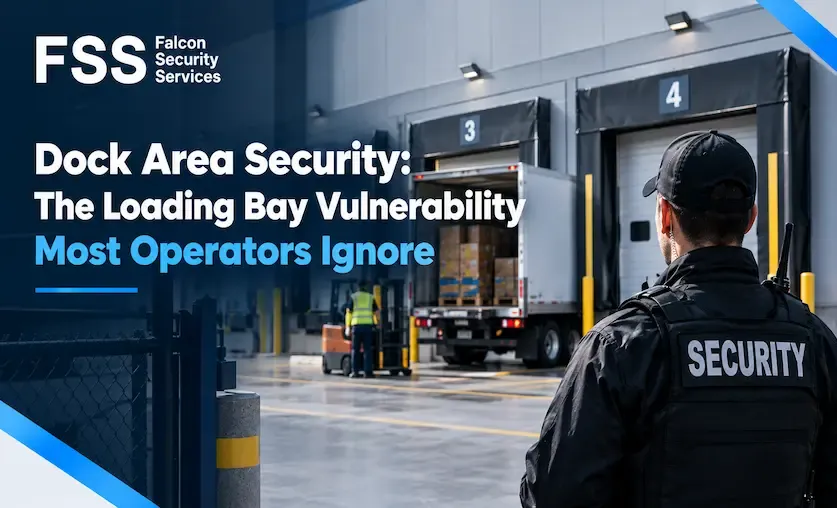
Every warehouse invests in its perimeter, then spends eight hours a day with a dozen doors standing wide open. The loading dock is where your building is deliberately unsealed, where outsiders are legitimately present, and where product physically changes hands — which is exactly why warehouse dock area security is the highest-yield control point in the entire facility. Most significant warehouse loss doesn’t involve a break-in; it leaves through a dock door on a load that looked correct. This guide covers the specific vulnerabilities and the controls that close them. For the wider picture, see our warehouse security services.
Why the dock concentrates risk
The dock is the one place where four risk factors meet at once: an opening in your building envelope, the presence of people who don’t work for you, goods in motion and therefore hard to count, and time pressure that discourages anyone from slowing down to check.
That combination produces the two loss patterns that dominate warehouse shrink. The first is collusion — a warehouse employee and a driver cooperating so extra product leaves on a legitimate load. It’s the costliest form of internal theft precisely because every element looks normal: an authorized employee, a scheduled carrier, a real load, correct-looking paperwork.
The second is fraudulent pickup, where someone presents as a carrier they aren’t, using convincing paperwork or a booking obtained through compromised broker channels, and simply drives away with the load. Nothing is broken into; the goods are handed over.
The vulnerabilities operators keep missing
Walk any dock during a busy shift and you’ll usually find several of these:
- Doors standing open with no sightline. Open dock doors are an access route into the building, not just an opening for freight.
- Drivers inside the warehouse. Drivers wandering to find a washroom, a supervisor, or a coffee are drivers observing your layout, your high-value storage, and your routines.
- Unattended staged loads. Product staged in a lane for hours before loading, unsupervised, is product that can be quietly added to or subtracted from.
- Seal control treated as paperwork. Seals applied but never recorded, or recorded but never verified at departure, provide no evidence at all.
- The propped side door. A break-area or smoking door jammed open is a common, chronic access gap near the dock.
- Trailers left unsecured at the door. A trailer parked against a dock door overnight without a lock is an unsupervised container attached to your building.
- No reconciliation of physical movement to paperwork. If nobody compares what actually went onto the truck with what the documents say, discrepancies are invisible until the customer complains.
Controls that actually work
Dock security is mostly discipline, not technology. The controls that move the needle are unglamorous and consistent.
Control the driver. Verify identity and the booking against your own scheduling records before loading — not against the paperwork the driver supplied, which is the document a fraudulent pickup would forge. Hold drivers in a designated waiting area with washroom access, so they never need to walk into the warehouse. Log every driver and carrier.
Run a real seal protocol. Record the seal number at application, note it on the documentation, verify it at departure, and check it on arrival for inbound loads. A seal is only evidence if its number is recorded and matched at both ends.
Supervise loading and unloading. Someone whose job is to watch the load — not the loader, who is busy. This is where on-site security officers earn their place in a warehouse, and it’s the single most effective counter to collusion.
Reconcile physically. Compare what moved to what the paperwork says, at the time, not at month-end.
Enforce door discipline. Doors closed when not in active use, side doors alarmed, and a culture where a propped door gets reported rather than ignored.
Cover every door on camera — and review it. Monitored camera coverage per dock door, with a defined review routine. Footage nobody watches documents losses rather than preventing them.
Worried your dock is the weak point? Book a consultation and we’ll walk it with you.
Where the dock meets the yard
Dock controls only hold if the yard behind them does. A load that’s been properly sealed and documented still sits in a trailer, in your yard, often overnight — which is why dock discipline and trailer yard security have to be designed as one system rather than two.
The handoff points matter most: trailer parked at the door, trailer moved to the yard, trailer collected by a carrier. Each is a custody transfer, and in a 3PL environment each needs a record. Get the dock right and you’ve addressed the largest share of warehouse loss; leave it to run on trust and no amount of fencing compensates.
Frequently Asked Questions
Q1. Why is the loading dock the biggest warehouse vulnerability?
Ans. It’s where the building is deliberately open, outsiders are legitimately present, goods are in motion and hard to count, and time pressure discourages checking — all at once.
Q2. What is a fraudulent or fictitious pickup?
Ans. It’s when someone presents as a carrier they aren’t, using convincing paperwork or a compromised booking, and drives away with the load. Nothing is broken into; the goods are handed over.
Q3. How do we prevent fraudulent pickups?
Ans. Verify driver identity and the booking against your own scheduling records rather than the documents the driver presents, and confirm with the carrier directly when anything doesn’t match.
Q4. Should drivers be allowed inside the warehouse?
Ans. Generally no. Provide a designated waiting area with washroom access so drivers never need to enter operational areas, where they could observe layout, stock, and routines.
Q5. What does proper seal control involve?
Ans. Recording the seal number at application, noting it on the paperwork, verifying it at departure, and checking it on arrival for inbound loads. An unrecorded seal proves nothing.
Q6. Why does dock collusion go undetected for so long?
Ans. Because every element looks legitimate — an authorized employee, a scheduled carrier, a real load, correct paperwork. There’s no visual signature of theft to notice.
Q7. Should someone supervise every load?
Ans. Supervision by someone other than the person loading is the most effective counter to collusion, which is why many operations place a security officer specifically at the dock.
Q8. How many cameras does a dock need?
Ans. Coverage of every dock door, plus staging areas — but the number matters less than whether anyone reviews the footage on a defined routine.
Q9. What about trailers left at dock doors overnight?
Ans. unsecured trailer at a door is an unsupervised container attached to your building. Lock it, or move it into a controlled yard area.
Q10. Where should we start improving dock security?
Ans. Start with driver control and seal protocol — they’re low-cost, high-yield, and they address both of the loss patterns that dominate dock-area theft.
The dock is the hinge your whole warehouse swings on. Control who comes in, keep drivers out of the building, run seals as evidence rather than paperwork, supervise the load, and reconcile at the time. Those habits close the gap most facilities never look at.
Ready to secure your loading bays properly? Request a consultation with our warehouse team.