
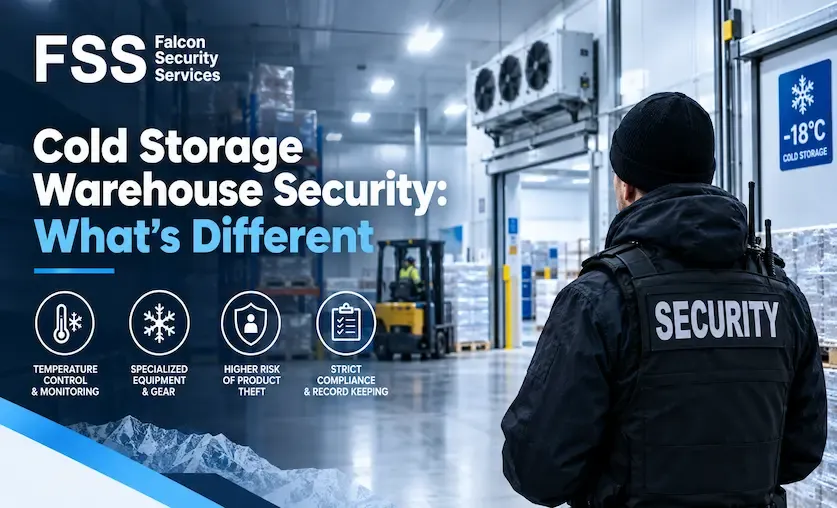
Cold storage is the one warehouse environment where a security failure can destroy your inventory without anyone stealing a thing. Cold storage warehouse security has to handle everything a normal facility does, plus a set of problems unique to refrigerated space: cameras and sensors that behave badly in sub-zero air, officers who physically cannot patrol a freezer the way they patrol a dry warehouse, ammonia refrigeration systems that create a genuine hazard, and a temperature chain where a door propped open overnight is a six-figure loss event. This guide covers what actually changes. For the wider picture, see our warehouse security services.
Temperature is a security issue, not just an operations one
In a dry warehouse, an open door is an access problem. In cold storage, it’s also a product problem. A freezer door left propped, a failed compressor overnight, or a sabotaged setpoint can spoil an entire room of inventory — often high-value food or pharmaceutical product — long before anyone notices.
That makes temperature monitoring part of your security picture rather than a separate facilities concern. Practically, it means alarms on temperature excursions and door-held-open conditions should escalate to someone who is actually present overnight, and your security team should know what to do when one triggers: check the door, confirm the room, and escalate to operations fast. An officer who treats a temperature alarm as “not my job” is a gap in the loss-prevention chain.
The same logic applies to cold chain integrity for regulated goods. Where product requires documented temperature control, a break in that record can condemn the stock even if the product is physically fine — so the response to an excursion is as much about documentation as reaction.
Equipment doesn’t behave the same way in the cold
This is the practical detail most security providers miss entirely. Standard equipment underperforms or fails in refrigerated and freezer environments:
- Cameras need appropriate ratings and housings. Lenses fog and frost, and condensation forms when units move between temperature zones.
- Batteries drain faster in the cold, which affects radios, portable devices, and anything wireless.
- Moving parts and seals suffer — door hardware, locks, and access control components all need specification for the temperature range.
- Condensation is relentless at the boundary between cold rooms and ambient areas, and it’s where electronics fail quietest.
The result is a facility that looks covered on paper while cameras are frosted over and sensors are offline. Any camera and monitoring system in cold storage must be specified for the environment and inspected on a routine, or you’re buying the appearance of coverage.
This is worth checking rather than assuming. Walk your cold rooms and look at the cameras themselves: if lenses are iced or housings are weeping condensation, those views have been useless for a while and nobody flagged it. Equipment installed by a general contractor who treated a freezer like any other room is a common and expensive discovery, usually made at the exact moment you need footage.
Ammonia and the safety dimension
Many large Canadian cold storage facilities use anhydrous ammonia as a refrigerant. It’s efficient and widely used — and it’s a hazardous substance that demands respect.
That has direct consequences for security staffing. Officers working in or around these facilities need WHMIS training including the site-specific portion covering the refrigerant on site, must know the evacuation and escalation procedure for a suspected release, and must understand the boundary of their role: recognize, secure the area, keep people out, escalate immediately — never attempt to investigate or intervene in a release.
A provider that places officers in an ammonia-refrigerated facility without that training isn’t just under-delivering on security; it’s creating a safety exposure for your site and theirs.
Running a refrigerated facility and unsure your coverage fits? Book a consultation and we’ll review it.
Patrol and staffing realities in refrigerated space
Officers can’t work a freezer the way they work a dry warehouse. Exposure times must be limited, appropriate cold-weather PPE is required, and patrol routes need designing around realistic time in cold areas rather than an idealized walk-through.
This is also where coverage models matter. Fixed monitored cameras specified for cold conditions carry more of the load inside freezer rooms, while officers concentrate on the dock, ambient areas, access points, and the perimeter. The classic cold storage theft pattern isn’t someone hiding in a freezer — it’s product diverted at the dock during loading, which is why dock controls and reefer trailer security in the yard deserve the bulk of your attention.
Lone-worker arrangements also need care. An officer alone in a sub-zero environment is a genuine safety risk, so check-in procedures and reliable communication are requirements, not refinements — and remember that the radio or phone they’d use to call for help is running on a battery that drains faster in the cold.
Staffing continuity matters more here than in most facilities, too. An officer who has worked your site for months knows which doors stick, which alarm is a recurring nuisance and which isn’t, and what a normal reefer hum sounds like. That familiarity is a detection system in itself, and it’s lost every time a provider rotates in someone new.
Frequently Asked Questions
Q1. What makes cold storage security different from a normal warehouse?
Ans. Temperature itself is a loss risk, equipment fails or underperforms in sub-zero air, ammonia refrigeration adds a hazard, and officers can’t patrol freezer space the way they patrol dry warehouses.
Q2. Why is temperature monitoring part of security?
Ans. Because a propped door, equipment failure, or altered setpoint can destroy inventory overnight. Temperature and door-held-open alarms need a response from whoever is actually on site.
Q3. Do regular security cameras work in a freezer?
Ans. Not reliably. Cameras need ratings and housings specified for the temperature range, or they frost, fog, and fail — leaving coverage that exists on paper but not in practice.
Q4. Is ammonia refrigeration dangerous?
Ans. Anhydrous ammonia is widely used and efficient, but it’s a hazardous substance. Anyone working in these facilities needs appropriate training and a clear evacuation and escalation procedure.
Q5. What should a security officer do if they suspect an ammonia release?
Ans. Recognize it, secure the area, keep people away, and escalate immediately to trained responders. Investigating or intervening is not part of the security role.
Q6. Do officers need WHMIS training for cold storage sites?
Ans. Yes, including the site-specific portion covering the refrigerant and hazardous products actually present at your facility — not just a generic certificate.
Q7. How should patrols work inside freezer areas?
Ans. With limited exposure times, proper cold-weather PPE, and routes designed around realistic time in the cold, supported by cold-rated fixed cameras carrying more of the monitoring load.
Q8. Where does cold storage theft usually happen?
Ans. Most commonly at the dock during loading and in the yard, rather than inside freezer rooms. That’s where supervision and controls should be concentrated.
Q9. What about reefer trailers in the yard?
Ans. They hold valuable temperature-controlled loads and need the same yard protections as any trailer, plus attention to whether refrigeration units stay running and intact.
Q10. Are lone officers safe in refrigerated facilities?
Ans. Only with defined check-in procedures, reliable communication, and a dependable way to summon help. A sub-zero environment makes lone working a genuine safety matter.
Cold storage demands a security model built for the environment, not adapted to it. Treat temperature as a loss risk, specify equipment that survives the cold, train officers for the refrigerant on your site, and concentrate human coverage where theft actually happens — the dock and the yard.
- Ready for coverage built for refrigerated facilities? Request a consultation with our warehouse team.