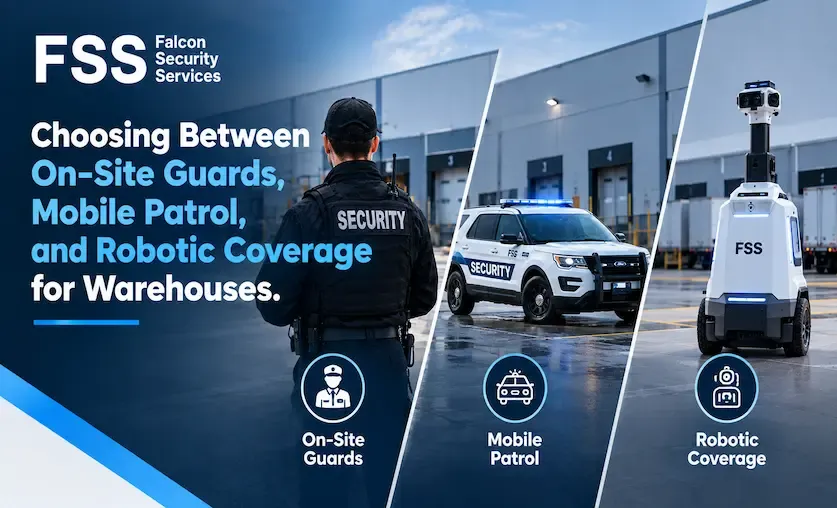
Most security buying starts with the wrong question — “how many guards do we need?” — when the right one is “which hours carry our risk?” Choosing between warehouse security coverage models turns on something specific to distribution: unlike a plant or a construction site, a warehouse’s biggest loss exposure often occurs while the building is fully staffed and busy. Product leaves through an open dock door at eleven in the morning far more often than someone cuts the fence at three in the morning. That single fact reshapes how on-site guards, mobile patrol, and robotic coverage should be deployed. For the wider picture, see our warehouse security services.
First, split your risk by hours
Before comparing models, divide your day into three windows, because each needs a different answer:
- Operating hours. The building is staffed, docks are open, carriers are coming and going. Risk here is dock loss, collusion, and fraudulent pickup — and it needs supervision, not patrol.
- After hours. The building is closed and empty. Risk is external intrusion, and especially trailers in the yard.
- Continuous operations. If you run 24/7, you have operating-hours risk around the clock — and the overnight shift, with the thinnest supervision, is often the most exposed.
Many warehouses get this backwards, buying overnight coverage for an empty building while the dock runs unsupervised all day. Map the hours first and the model usually chooses itself.
On-site guards: supervision where goods move
A dedicated on-site officer is the only model that delivers continuous presence at a specific point during operating hours.
What it does well: dock and loading bay supervision, driver check-in and identity verification, access control for visitors and contractors, and being a visible deterrent to the collusion patterns that dominate warehouse loss. An officer stationed at the dock is watching the exact place where most product actually walks out — and because they’re watching full-time, they see the pattern a passing patrol never would.
Where it falls short: it’s a fixed point. An officer at the dock isn’t watching the yard, and continuous on-site coverage is the most labour-intensive option per hour, so it should be deployed where it does real work rather than spread thin as a token presence.
Best fit: busy docks, high-value inventory, multi-client 3PL facilities with audit obligations, and any site where goods change hands frequently.
Mobile patrol: the after-hours and multi-site answer
Mobile patrol visits on varied routes and timings, either dedicated to one site or circulating across several.
What it does well: it covers yard, perimeter, and building exterior on an unpredictable schedule, which is a genuine deterrent for an empty facility. It handles alarm response and lock-up checks, and it’s efficient for operators running a network of distribution centres — one of the few models that scales sensibly across a portfolio.
Where it falls short: coverage is periodic. Between visits the site is unwatched, and a thief observing the yard can work in the gaps. Patrol frequency is the variable that matters, and stretching one patrol across too many sites reduces it to a drive-by.
Best fit: closed facilities overnight and on weekends, trailer yards, and multi-site distribution networks.
Robotic coverage: consistency in defined space
Robotic security runs set routes repeatedly, feeding video and sensor data to a monitoring point.
What it does well: it never gets bored. Repeatable patrol of warehouse aisles or defined indoor routes at 4 a.m. is exactly the task where human attention degrades, and the continuous data it generates is useful over time.
Where it falls short: it cannot respond. A robot detects and reports; it doesn’t verify a driver, supervise a load, intervene, or exercise judgment. Routes are predictable, and it needs the smooth, uncluttered surfaces that warehouse aisles have and yards often don’t.
Best fit: large indoor footprints, defined routes, and long quiet hours alongside human response.
Not sure which model your sites need? Book a consultation and we’ll map it with you.
Side-by-side comparison
| Factor | On-site guard | Mobile patrol | Robotic coverage |
| Coverage type | One point, continuously | Many points, periodically | Fixed route, repeatedly |
| Best window | Operating hours | After hours | Overnight / quiet hours |
| Main strength | Dock supervision, access control | Yard and multi-site reach | Consistency, continuous data |
| Main limitation | Fixed to one location | Gaps between visits | Cannot respond or judge |
| Human response | Yes | Yes | No |
| Scales across sites | Poorly | Well | Per-site |
How most warehouses should combine them
A workable default for a single-shift distribution centre: an on-site officer at the dock during operating hours, mobile patrol covering the yard and perimeter after close, and monitored cameras tying both together with someone actually reviewing them.
For a 24/7 fulfillment operation, extend on-site coverage across all shifts — weighting the overnight shift, where supervision is thinnest — and use robotic or camera coverage for interior routes. For a multi-site network, standardize the model and vary the intensity by each site’s risk, which is exactly what a well-built multi-site contract should allow.
Whatever the mix, the deciding question is the same: when something is detected, who responds, and how fast? If the answer is nobody until morning, more detection won’t help until that changes.
Frequently Asked Questions
Q1. Do warehouses need security during operating hours or just overnight?
Ans. Often both, but operating hours are frequently the bigger exposure. Most warehouse loss leaves through the dock on a load that looks legitimate, which happens while the building is busy.
Q2. What’s the difference between an on-site guard and mobile patrol?
Ans. An on-site guard holds one point continuously, supervising the dock and controlling access. Mobile patrol visits periodically on varied routes, covering far more ground but only at intervals.
Q3. Where should an on-site officer be stationed?
Ans. Usually the dock or the main access point — wherever goods and outside people actually meet, since that’s where the dominant loss patterns occur.
Q4. Is mobile patrol enough for an empty warehouse overnight?
Ans. For many sites yes, provided the frequency is adequate and timings are varied. Higher-risk yards with loaded trailers often need additional detection and faster response.
Q5. Can robotic coverage replace security guards?
Ans. No. Robots provide consistent detection but can’t verify a driver, supervise a load, respond to an incident, or exercise judgment. They complement officers rather than replacing them.
Q6. How often should mobile patrols visit a closed facility?
Ans. It depends on risk and what’s staged in the yard, but frequency is the key variable — and the schedule should be varied, since predictable patrol times are easy to work around.
Q7. Which model works best for a multi-site network?
Ans. Mobile patrol scales best across a portfolio, usually combined with on-site coverage at the highest-risk or highest-volume sites. The model should be standardized with intensity varied per site.
Q8. Does a 24/7 fulfillment centre need different coverage?
Ans. Yes. Operating-hours risk runs around the clock, so coverage should extend across all shifts, with particular weight on overnight when supervision is thinnest.
Q9. How do cameras fit alongside these models?
Ans. As the connective layer — but only when someone monitors and reviews them. Cameras that simply record document losses instead of preventing them.
Q10. How do we decide the right mix?
Ans. Split your risk by hours, match each window to the model that addresses it, and confirm who responds to a detection and how quickly. That usually settles it.
- Warehouse coverage isn’t about headcount, it’s about hours. Put supervision where goods change hands during the day, patrol the yard and perimeter when the building empties, add consistent automated coverage where routes repeat — and make sure someone can respond whenever detection happens.
- Ready to match coverage to your operation? Request a consultation with our warehouse team.