
Most people reading this are in one of two situations. Either you are planning ahead — building an emergency response into your security coverage before you need it. Or something has already happened: the fire panel is out of service, a guard did not show up for the night shift, the building was broken into yesterday and the door is still being repaired.
Both situations point to the same answer, but they move at very different speeds. This guide covers what an emergency security guard actually does, the specific events that trigger a call, and how quickly cover can be arranged when a site is exposed right now.
What Is an Emergency Security Guard?
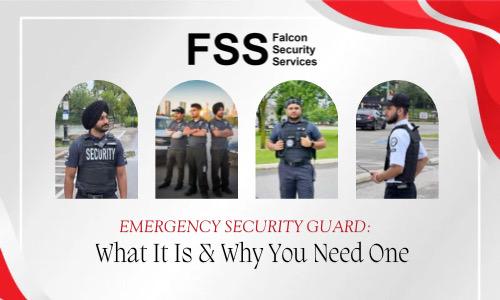
An emergency security guard is a licensed security professional trained to respond to crisis situations rather than work a routine static post. Where a standard guard’s day is built around surveillance, access control and patrol, an emergency guard is prepared for the unpredictable — alarms, evacuations, medical incidents, intrusions and severe weather events.
- Rapid assessment — reading a developing situation quickly and acting on it without waiting for instruction
- Crisis management — staying composed under pressure and de-escalating before a situation grows
- Adaptability — arriving at an unfamiliar site and working effectively within the first hour
That last point matters more than it sounds. Emergency guards are routinely posted to buildings they have never worked before, which is why briefing and documentation are part of the role rather than an afterthought. These are the same licensed security guards used on permanent posts — the difference is training and how they are deployed.
Emergency Security Guard Duties by Situation
Emergency security guard duties change with the incident. What stays constant is the sequence: assess, act, communicate, document.
| Situation | What the guard does | Who they coordinate with |
| Fire alarm or system failure | Investigates the activation, keeps watch on affected areas, starts evacuation if required | Fire services, building management |
| Medical emergency | Provides first aid or CPR within their training, clears access, meets and directs paramedics | Paramedics, the occupant’s contacts |
| Break-in or intrusion | Secures the scene, preserves evidence, prevents re-entry while repairs are arranged | Police, property manager, insurer |
| Flood, storm or building damage | Controls access to unsafe areas, protects an open or damaged building | Trades, restoration crews, management |
| Crowd incident or disturbance | De-escalates, separates parties, removes individuals where necessary | Police, event or venue staff |
| Evacuation | Directs people along planned routes, checks areas are clear, manages the muster point | Fire services, floor wardens |
Across all of these, four duties run constantly:
- Assess and triage — judging severity fast and deciding what happens first
- Initiate the protocol — raising alarms, calling 911, starting evacuation procedures
- Communicate — acting as the link between occupants, management and responders, and meeting responders at the entrance to direct them
- Document — recording what happened, when, and what was done about it
Documentation is the duty most often underestimated. The guard’s written record is what supports the insurance claim, the incident review and any legal process that follows. If you want the occupant’s side of the same events, our guide on what to do during a security threat covers it.
Two Ways Buildings Use Emergency Security Guards
Emergency security guard services are bought in two very different ways, and knowing which one you need changes who you call and what you ask for.
1. Planned emergency response capability
This is emergency readiness built into a guard post you already have.
- Written emergency protocols for your building, not a generic template
- Guards trained and drilled on those protocols before anything happens
- Defined escalation steps — who is called, in what order, at what threshold
- Incident reporting that feeds back into the plan after every event
Most buildings should have this whether or not they ever have an emergency. It costs nothing extra at the point of crisis because the work was done in advance.
2. Short-notice deployment
This is cover arranged quickly when a site becomes suddenly exposed — short notice security guards posted to a building that had none planned for tonight.
- Cover for a post left uncovered without warning
- Interim security while damage or a failed system is being repaired
- Temporary cover during a gap between security providers
- Same day security guard cover where availability allows
How quickly cover starts depends on three things: where the site is, what hours you need, and what the post involves. Give a provider those three details on the first call and they can tell you what is realistic. Where a site needs regular checks rather than a guard standing on it continuously, mobile patrol cover is often the faster and more practical option.
When You Need an Emergency Security Guard
It is rarely a building type that triggers the call — it is an event. These are the situations that most often leave a site needing cover at short notice:
- Your fire alarm or sprinkler system is out of service. Buildings are generally required to put a fire watch in place while fire protection is impaired. See why building owners must have fire watch during alarm outages and our fire watch coverage.
- A guard or shift does not show up. An uncovered post is an exposed building, and the exposure starts the moment the shift was due.
- The hours and days after a break-in. Doors, windows and locks take time to repair, and a building that has already been targeted is more likely to be targeted again.
- Flood, storm or fire damage has left a building open. Restoration work keeps access points open and brings unfamiliar trades on site.
- A security contract has ended abruptly. Gaps between providers are a common and entirely avoidable exposure.
- A dispute, protest or termination with a credible risk of escalation. Short-term cover during a tense period is far cheaper than dealing with what it prevents.
- A one-off event or a sudden surge in foot traffic. Planned gatherings are usually better served by dedicated event security.
Need cover tonight?
Call Falcon Security Services on +1 905-330-5515. Tell us the location, the hours you need and what the post involves, and we will tell you what we can put in place.
Training and Licensing in Canada
An emergency security guard is only as good as what they have been trained to do before they arrive. Training usually covers:
- First aid and CPR — the minutes before paramedics arrive are the ones that count
- Crisis intervention and de-escalation — managing distressed or aggressive people without escalating the situation
- Fire safety and evacuation — operating fire systems and leading people out along planned routes
- Incident documentation — writing records that hold up for insurers and in legal proceedings
- Coordination with emergency services — working alongside police, fire and paramedics rather than around them
Advanced scenarios, including active threat response, are covered in specialist programmes beyond the standard curriculum.
Security guards in Canada are licensed under provincial security services legislation, and requirements vary from province to province. Ask any provider which licence class their guards hold, what training they complete beyond the minimum, and how often it is refreshed.
What to Ask Before You Call
When you are arranging cover under pressure, five questions separate a provider who can help from one who cannot:
- Are your guards licensed and insured for this work? Ask for it in writing, even at short notice.
- How quickly can cover start, and for how long? A provider should be able to give you a straight answer about this site, these hours.
- What is the guard briefed with before they arrive? An emergency guard walking into an unfamiliar building needs site access details, key contacts and the specific reason they are there.
- What reporting do I receive during the deployment? Agree the format and frequency before the first shift, not after it.
- What happens when the emergency ends? Short-notice cover often becomes an ongoing arrangement. Know how that transition works, and review the contract terms properly — our questions to ask before signing a security contract covers what matters.
If the deployment looks likely to continue, work out the coverage you actually need rather than carrying emergency staffing indefinitely. Our guide to how many guards your site needs is the right next step.
Falcon Security Services provides licensed security guards across Ontario and Alberta, with offices in Ottawa, Mississauga and Calgary, for planned emergency response and for cover arranged at short notice. Request a security assessment — the assessment is complimentary — or call us on +1 905-330-5515 to talk through what your site needs.
Frequently Asked Questions
Q1. What is an emergency security guard?
Ans. An emergency security guard is a licensed security professional trained for crisis response rather than routine static duty — handling alarms, evacuations, medical incidents and intrusions, and coordinating with emergency services. The same guards are often deployed at short notice when a site is suddenly left exposed.
Q2. What does an emergency security guard do during an incident?
Ans. They assess the situation, start the correct protocol, call and then direct emergency services, keep people away from the hazard and document everything that happened. The written record is what supports the insurance claim afterwards.
Q3. How is an emergency security guard different from a regular security guard?
Ans. Both are licensed guards. The difference is training and deployment — emergency guards are prepared for crisis response and are used to being posted at short notice to a site they do not already know.
Q4. When should I call for an emergency security guard?
Ans. Common triggers are a fire alarm or sprinkler system out of service, an uncovered post after a guard no-show, the hours after a break-in while repairs are made, storm or flood damage leaving a building open, and an abrupt end to a security contract.
Q5. Can security guards be arranged at short notice?
Ans. Yes — short-notice and after-hours deployment is a standard part of emergency security work. How quickly cover starts depends on the location, the hours required and what the post involves, so give the provider those three details when you call.
Q6. Do I need an emergency security guard if my fire alarm is out of service?
Ans. Buildings are generally required to put a fire watch in place while fire protection systems are impaired, and the requirement comes from your fire code and your insurer rather than from the security provider. Confirm what applies to your building before the system goes down.
Q7. What training do emergency security guards have?
Ans. First aid and CPR, crisis intervention and de-escalation, fire safety and evacuation procedures, incident documentation, and working alongside police, fire and paramedics. Guards are licensed under their province’s security services legislation.
Q8. What should I ask a provider before hiring emergency security?
Ans. Ask about licensing and insurance, how quickly cover can start, what the guard is briefed with before arriving, what reporting you receive during the deployment, and what happens when the emergency ends.