
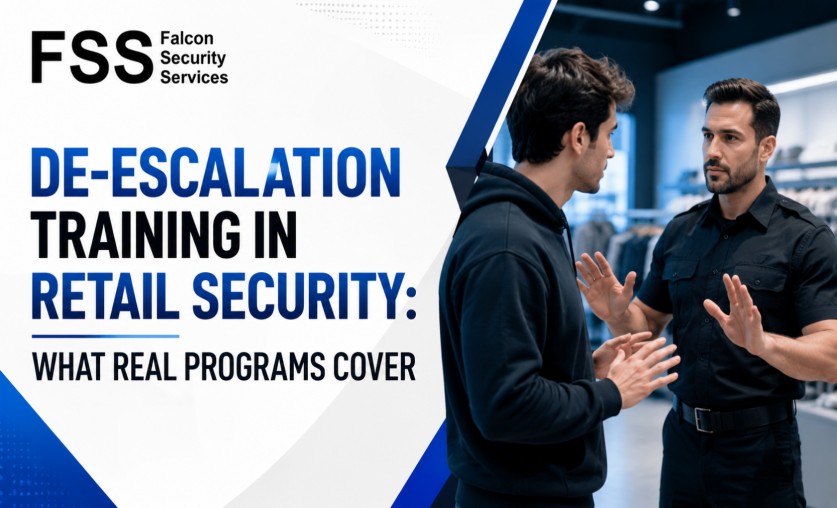
When a theft turns confrontational, the officer’s training decides whether it ends calmly or badly. De-escalation training in retail security has moved from a nice-to-have to a core requirement, because retail crime has turned violent: the Retail Council of Canada reports that roughly 45% of organized retail crime incidents in 2024 involved violence against staff or customers. A real program teaches officers to read tension early, defuse it with communication, disengage safely, and treat physical force as a genuine last resort. This guide explains what strong de-escalation training actually covers, so you can tell a real program from a checkbox. For how we train and deploy officers, see our retail security and loss prevention services.
Why de-escalation is now essential in retail
Retail used to treat conflict as an edge case. It isn’t anymore. With nearly half of organized incidents involving violence, and confrontations flaring over everything from theft to returns to stock shortages, the officer on your floor is far more likely to face a heated situation than a calm one.
That changes the job. The goal of a modern retail officer isn’t to “win” confrontations — it’s to prevent them from escalating and to protect people when they do. An officer trained only for physical presence, with no de-escalation skill, is a liability in exactly the moments that matter most. This is as true for uniformed guards as for loss prevention officers.
It’s worth being clear about who de-escalation protects. It’s not only the officer — it’s your cashiers, your customers, and even the person causing the disturbance, who may be intoxicated, in crisis, or simply desperate. A confrontation that turns physical can injure any of them and can traumatize the staff who witness it. De-escalation is, at its core, a way of keeping everyone in the store safe when a situation goes sideways, which is why it belongs in every retail security deployment rather than just the high-risk ones.
What a real program teaches
Genuine de-escalation training is skills-based and practised, not a slideshow. Strong programs cover:
- Reading escalation early. Recognizing the body language, tone, and behaviour that signal rising tension before it becomes a crisis.
- Verbal de-escalation. Calm tone, simple language, active listening, giving space and time, and avoiding the power struggles that make things worse.
- Non-confrontation and disengagement. Knowing when not to engage, how to create distance, and how to withdraw safely — because walking away is often the right call.
- The use-of-force continuum. Understanding that physical intervention is a last resort, tightly bounded by law, and used only when someone’s safety is at genuine risk.
- Scenario-based practice. Rehearsing realistic situations — theft, aggression, medical or mental-health crises — so the response is trained, not improvised.
- Legal boundaries. What officers can and can’t do, tied to lawful apprehension and use-of-force law.
The difference between a program that covers these and one that doesn’t shows up the first time a situation turns tense.
Safety over merchandise — the policy that must be explicit
The single most important thing de-escalation training reinforces is that people matter more than product. No item on the shelf is worth an injury to staff, a customer, or an officer.
That means clear, written policies that officers never pursue fleeing thieves into parking lots or streets, never physically fight over merchandise, and always prioritize safety. Counterintuitively, this makes stores safer and reduces liability — most serious retail incidents and lawsuits stem from confrontations that should have been let go. If your provider’s officers chase and grab, that’s not toughness; it’s risk.
This is often the hardest policy for retailers to accept emotionally, because watching someone walk out with unpaid goods feels like losing. But the math is stark: the merchandise is recoverable through insurance, investigation, and prevention, while an injury or a wrongful-detention lawsuit is not. Trained officers are taught to hold that line under pressure — to let the product go and keep the people safe — and a provider who reinforces it is protecting your business, not underperforming.
Want to know whether your officers are trained to de-escalate? Book a consultation and we’ll review it with you.
How to verify a provider’s training
Training claims are easy to make, so ask for specifics. A credible provider can tell you which recognized de-escalation or conflict-management program its officers complete, how often it’s refreshed, whether it includes scenario practice, and how it’s tied to their loss prevention and uniformed guard deployments. Vague answers — “all our staff are trained” with no detail — tell you what you need to know. The same rigour belongs in your retail security RFP. Better still, ask how officers are assessed after training, not just whether they attended: a certificate on file proves someone sat in a room, while a practical evaluation proves they can actually do it when a situation heats up.
Frequently Asked Questions
Q1. Why is de-escalation training important in retail?
Ans. Because retail crime has turned violent — the RCC reports about 45% of organized incidents in 2024 involved violence — so officers routinely face confrontations. De-escalation keeps those situations from turning dangerous.
Q2. What does de-escalation training actually teach?
Ans. Reading rising tension early, verbal techniques to defuse it, safe disengagement, the limits of using force, scenario practice, and the legal boundaries of intervention. It’s skills-based, not a lecture.
Q3. Should uniformed guards and loss prevention officers both get it?
Ans. Yes. Both roles encounter confrontation, so both need de-escalation skills. It’s not exclusive to one type of officer.
Q4. Is de-escalation just about talking someone down?
Ans. Largely, but it also includes knowing when not to engage, how to create distance, and when to withdraw. Sometimes the best de-escalation is disengagement.
Q5. Does de-escalation training reduce liability?
Ans. Yes. Many serious retail incidents and lawsuits come from confrontations that escalated unnecessarily, so training officers to defuse and disengage lowers both harm and legal exposure.
Q6. Should officers ever chase a shoplifter?
Ans. Generally no. Pursuing fleeing thieves into parking lots or streets is dangerous and a common source of injury and liability. Safety-first policies prohibit it.
Q7. How often should de-escalation training be refreshed?
Ans. Regularly — skills fade without practice. Look for providers who refresh training on a defined schedule rather than treating it as one-time onboarding.
Q8. What’s the difference between de-escalation and use of force?
Ans. De-escalation prevents or resolves conflict without physical contact; use of force is a tightly bounded last resort when safety is at direct risk. Good training makes force rare.
Q9. Can de-escalation training help with non-theft situations?
Ans. Yes. The same skills apply to disputes over returns, queues, intoxication, or mental-health crises, which is why it’s valuable well beyond shoplifting.
Q10. How do I confirm a vendor really trains for this?
Ans. Ask which recognized program their officers complete, how often it’s refreshed, and whether it includes scenario practice. Specific answers signal a real program; vague ones don’t.
De-escalation training is what turns a security presence into a safe one. In an era where nearly half of organized retail incidents involve violence, officers who can read tension, defuse conflict, and put safety over merchandise are the difference between a contained situation and a headline.
Ready for a security team trained for the hard moments? Request a consultation with our retail team.