
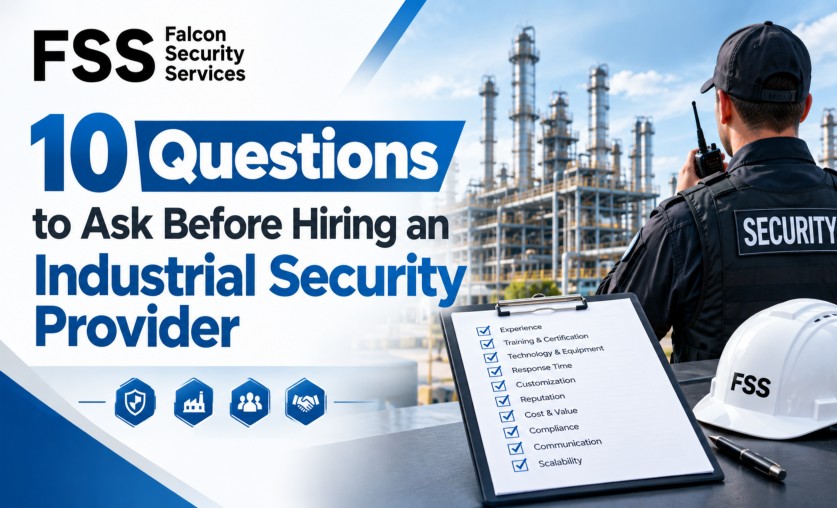
Every security provider will tell you they can cover an industrial site. Far fewer actually can. Before you hire industrial security guards, the fastest way to separate the two is to ask questions a generalist can’t answer well — about hazardous materials, emergency response, fill rates, and what happens at 3 a.m. when nobody from your team is on site. The ten below are the ones that consistently reveal the difference. The rule throughout: demand evidence, not adjectives. A capable provider answers with records, numbers, and specifics; a weak one answers with reassurance. For the standard to hold providers to, see our industrial security services.
Credentials and industrial competence
1. Is every officer licensed for our province, and how do you verify it continuously?
In Ontario that means valid PSISA licensing. Ask how they track expiry and what happens if a licence lapses mid-contract — the answer reveals how tightly they actually run compliance.
2. Are your officers WHMIS trained, and how do you handle site-specific training?
This is the single best filter for industrial capability. A general certificate covers the portable education portion only; officers also need training on your hazardous products and procedures, as our WHMIS guide explains. A provider who doesn’t know that distinction isn’t an industrial provider.
3. What industrial experience do you actually have?
Ask for comparable sites — manufacturing, energy, chemical, heavy industrial — and the kinds of incidents they’ve handled. Be wary of a provider who pivots to retail or condo experience when you ask. Industrial work carries obligations a shopping-centre post never does: hazardous products, confined spaces nearby, contractor movements, and safety duties that sit alongside the security ones.
4. What insurance and liability coverage do you carry?
Confirm it’s appropriate for an industrial environment, that it sits with the agency rather than the individual officer, and ask to see proof rather than a promise to send it later.
Operations and reliability
5. What are your real turnover and shift-fill rates?
This is the most overlooked question in security procurement and the one that predicts your experience best. An unstaffed post overnight is a direct loss and safety failure. Ask for numbers, and ask specifically how they cover a last-minute callout at 2 a.m. Continuity matters as much as coverage: an officer who has worked your site for a year knows your layout, your contractors, and what “normal” looks like — a rotating cast of strangers never does.
6. How do you supervise officers and assure quality?
Ask about site supervision, spot checks, and how they detect a post that’s slipping. If nobody audits the site and you’ve never met a supervisor, standards drift with no one watching. Ask how often a supervisor physically attends your site, and whether those visits happen overnight as well as during business hours — the shift where oversight matters most is the one that usually gets least.
7. How do you handle patrol verification and reporting?
Look for time-stamped, checkpoint-based patrol logs and incident reports you can access. Documented coverage proves the site was actually patrolled and shows you where activity clusters. Ask whether you get direct access to that data or have to request it — a provider confident in its delivery gives you the dashboard; one that isn’t keeps reporting on a need-to-know basis.
Building your shortlist now? Book a consultation and we’ll help you pressure-test it.
Safety, response, and partnership
8. What happens when your officer is first on scene at a serious incident?
This question separates professionals from everyone else. A capable provider will describe securing the area, notifying immediately, documenting, and — critically — not disturbing the scene of a critical injury, as our guide to OHSA and security operations covers. A blank look here is disqualifying on an industrial site.
9. How do you handle lone workers and after-hours safety?
Your overnight officer is often alone on a large site. Ask about check-in procedures, communication, and how they’d summon help — both for the officer’s safety and because it reflects how seriously they take after-hours coverage.
10. What KPIs will you commit to in writing, and what drives your pricing?
Response times, fill rates, and reporting turnaround should be contractual with consequences for misses. On price, you’re not hunting the lowest number — you’re asking what shapes it (training, supervision, insurance, fill guarantees) so you can compare bids on the same basis. An unusually low bid has usually had something stripped out, and you’ll pay for it later in turnover and gaps.
What to do with the answers
Score responses on evidence, not polish. Then verify before deciding: call references at comparable industrial sites and ask what went wrong during the relationship and how it was handled — every provider has had a bad shift, and the ones worth hiring are candid about it. Meet the supervisor who’ll actually run your account, not just the pitch team.
Finally, make sure everything you agreed lands in the contract; our guide to industrial security service agreements covers the clauses that matter, and the weaknesses these questions surface are the same signs of an underperforming vendor you never want to discover after signing.
Frequently Asked Questions
Q1. What’s the most important question to ask an industrial security provider?
Ans. Whether officers are WHMIS trained and how site-specific training is delivered. It’s the fastest filter between a genuine industrial provider and a general guarding company.
Q2. Why do fill rates matter so much?
Ans. Because an unstaffed post is a direct loss and safety failure. A provider that can’t reliably staff your site has a broken model, not a temporary glitch.
Q3. Do industrial security guards need special licensing?
Ans. They need standard provincial security licensing — PSISA in Ontario — plus the industrial-specific training the site demands, such as WHMIS and site induction.
Q4. How do I verify a provider’s training claims?
Ans. Ask for training records, ask how site-specific training is delivered for your products, and ask what triggers a refresh. Documented answers are the marker; a generic certificate isn’t.
Q5. Should we check references?
Ans. Yes, and ask comparable industrial sites specifically about reliability and how problems were handled. Candour about past issues is a better signal than a flawless account.
Q6. What should we ask about emergency response?
Ans. How officers respond when first on scene, including securing the area, notifying, documenting, and not disturbing a critical injury scene. Also ask about evacuation and hazard escalation procedures.
Q7. Is the cheapest bid ever the right choice?
Ans. Rarely. A low bid usually means training, supervision, or wages have been cut, and those savings return as turnover, unfilled shifts, and incidents.
Q8. How many providers should we invite to bid?
Ans. Enough for genuine comparison without overwhelming your evaluators. A shortlist of qualified, industrial-experienced providers beats a large field of generalists.
Q9. Should KPIs be in the contract?
Ans. Yes. Response times, fill rates, and reporting turnaround should be written in with defined consequences, or they’re just talking points from the pitch.
Q10. What happens after we choose a provider?
Ans. A structured onboarding including site induction and hazard training, then regular performance reviews against the KPIs you agreed.
Hiring industrial security is about capability, not coverage hours. Ask about licensing, WHMIS and site-specific training, fill rates, supervision, and what happens when an officer is first on scene — then verify the answers. Ten good questions asked before you sign save a year of problems afterwards.
Ready to evaluate providers properly? Request a consultation with our industrial team.