
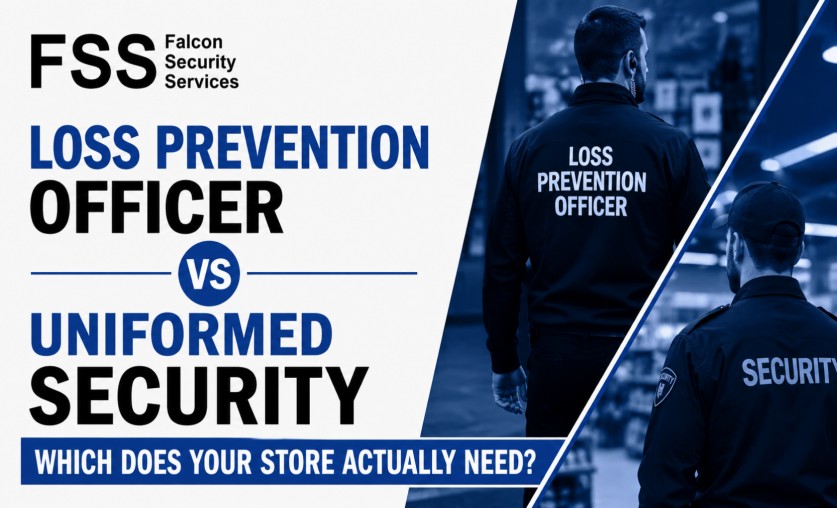
The loss prevention officer vs security guard question comes down to what you’re trying to achieve: deter theft before it happens, or detect and resolve it when it does. A uniformed security guard is visible deterrence — presence, access control, and first response. A loss prevention officer is usually plain-clothes, trained to observe, document, and lawfully apprehend. Both are licensed, both matter, and many stores need a blend. The mistake is buying one when the risk calls for the other — a greeter at the door won’t dismantle an organized boosting operation, and a plain-clothes officer alone won’t reassure nervous evening staff. Here’s how to match the model to your store. For the full picture, see our retail security and loss prevention services.
What a uniformed security guard does
A uniformed guard’s value is that everyone can see them. That visibility is the point: it deters opportunistic theft, reassures staff and customers, and signals that a location is watched.
Their role centres on presence and response — standing post at entrances, controlling access, monitoring the floor, responding first to incidents, and being the obvious person to approach when something goes wrong. In a store where the main need is deterrence and a calm environment, a uniformed presence often does most of the job on its own.
What a loss prevention officer does
A loss prevention officer works the opposite way — by not being obvious. Usually plain-clothes, they blend in to observe behaviour, identify theft in progress, gather evidence, and intervene within the law.
This is a specialized role. LP officers are trained to recognize theft patterns, document incidents to a standard that stands up later, and — critically — to apprehend lawfully. Under the Criminal Code (section 494), a store owner or their authorized agent may arrest a person found committing an offence on the property, but doing it wrongly exposes the retailer to serious liability. That’s why a trained, licensed loss prevention officer is worth far more than an untrained one: the skill isn’t just spotting theft, it’s resolving it without creating a bigger legal problem than the theft itself.
The legal point you can’t skip
Here’s where retailers get into trouble. In Ontario, loss prevention personnel — including plain-clothes officers — must be licensed under the Private Security and Investigative Services Act (PSISA), just like uniformed guards. There’s no “it’s just an observer” exemption when the person is performing security work.
And apprehension carries real risk. Wrongful arrest, excessive force, or unlawful detention can turn a shoplifting incident into a lawsuit. A capable provider trains officers on the limits of section 494, on use-of-force law, and on when not to intervene. If a vendor is casual about this, treat it as a red flag — the kind we cover in signs your vendor isn’t performing.
LP officer vs uniformed guard: a side-by-side
| Factor | Uniformed security guard | Loss prevention officer |
| Visibility | High — deterrence by presence | Low — plain-clothes, blends in |
| Primary purpose | Deter, control access, first response | Detect, document, lawfully apprehend |
| Best against | Opportunistic theft, disorder | Organized and repeat theft |
| Licensing (Ontario) | PSISA required | PSISA required |
| Key risk to manage | Presence gaps | Wrongful arrest / use-of-force liability |
| Reassures staff/customers | Strongly | Indirectly |
Not sure which model your stores need? Book a consultation and we’ll assess it location by location.
How to choose — and why most stores blend
The right answer depends on your risk profile, not fashion:
- Lead with uniformed presence where deterrence and reassurance are the priority — high-traffic entrances, evening shifts, stores in areas with visible theft or disorder.
- Deploy loss prevention where organized or repeat theft is the real problem, and you need to detect, document, and resolve it — often the driver behind organized retail crime losses.
- Blend the two in higher-risk stores, so you deter what you can and catch what you can’t. Both need de-escalation training given how often incidents turn confrontational.
For multi-store operators, the mix should be set deliberately, store by store, as part of a wider loss prevention program rather than a one-size decision. A flagship location with high foot traffic and premium stock has different needs than a small-format store in a quiet plaza, and applying the same model to both wastes money in one place and leaves a gap in the other. The right question is never “guards or LP?” in the abstract — it’s “what does this store, on these shifts, actually need?”
Frequently Asked Questions
Q1. What’s the main difference between a loss prevention officer and a security guard?
Ans. A uniformed guard deters theft through visible presence and handles first response; a loss prevention officer is usually plain-clothes and trained to detect, document, and lawfully apprehend. One prevents, the other resolves.
Q2. Do loss prevention officers need a licence in Ontario?
Ans. Yes. Loss prevention personnel, including plain-clothes officers, must be licensed under PSISA just like uniformed guards. Performing security work without a licence isn’t permitted.
Q3. Can a loss prevention officer arrest a shoplifter?
Ans. Under the Criminal Code, a store’s authorized agent may arrest someone found committing an offence on the property, but it must be done lawfully. Training on the limits of that power is essential to avoid liability.
Q4. Which is better for deterring theft — uniformed or plain-clothes?
Ans. Uniformed presence is the stronger deterrent because it’s visible; plain-clothes LP is better at catching theft that isn’t deterred. Many stores use both for that reason.
Q5. Are uniformed guards enough to stop organized retail crime?
Ans. Visible guards deter opportunists but rarely dismantle organized boosting on their own. Detecting and documenting coordinated theft usually needs trained loss prevention.
Q6. What’s the biggest risk with loss prevention apprehensions?
Ans. Wrongful arrest, excessive force, or unlawful detention, any of which can turn a minor theft into a costly lawsuit. Proper training on lawful apprehension is the safeguard.
Q7. Can one officer do both roles?
Ans. Roles can overlap, but the skill sets differ — deterrence and reassurance versus covert detection and lawful apprehension. What matters is that whoever fills the role is licensed and trained for it.
Q8. Which model is more expensive?
Ans. Cost depends on training, risk, and scope rather than the label. Choosing the cheaper model for a store that needs the other usually costs more once losses and liability are counted.
Q9. How do I decide the right mix for my store?
Ans. Base it on your risk: deterrence needs point to uniformed presence, organized or repeat theft points to loss prevention, and higher-risk stores usually justify both. A risk assessment makes the call clear.
Q10. Do both roles need de-escalation training?
Ans. Yes. Because retail incidents frequently turn confrontational, both uniformed and plain-clothes officers should be trained to de-escalate and to prioritize safety over merchandise.
Loss prevention and uniformed security aren’t competitors — they solve different problems. Match uniformed presence to deterrence, loss prevention to detection and lawful resolution, keep everyone licensed and trained, and blend the two where the risk demands it. That’s how you protect margin without creating new liabilities.
Want help designing the right mix for your stores? Request a consultation with our retail team.