
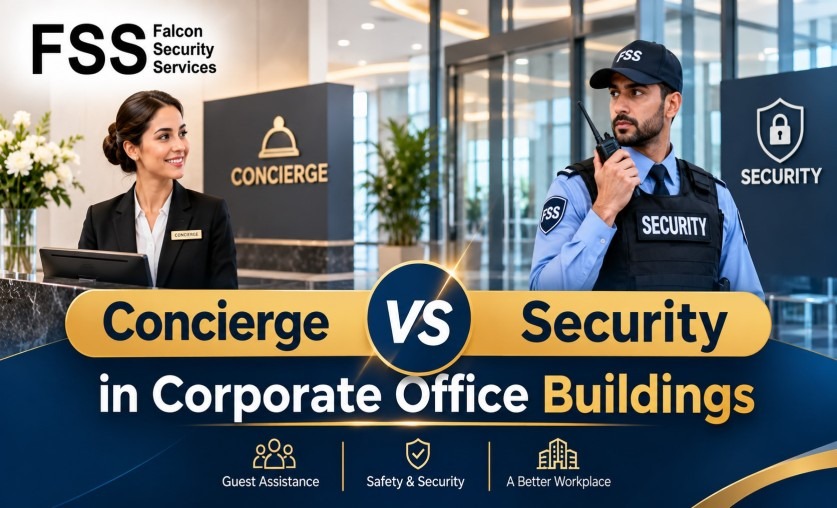
In an office tower, the lobby is both a control point and a shop window. That tension is what makes the corporate concierge vs security decision harder than it looks: landlords are competing for tenants on experience, so the desk needs to feel welcoming — yet it’s also the single place where everyone entering the building is seen, assessed, and either admitted or stopped. Choose a pure concierge and you get warmth without capability. Choose a hard security presence and you get a tower that feels like a checkpoint. Most Canadian office buildings land somewhere in between, deliberately. Here’s how to decide. For the wider picture, see our corporate office security services.
What each role is built to do
A concierge is oriented around service and the tenant experience: greeting arrivals, directing visitors, receiving couriers and packages, assisting with building amenities, and being the friendly face that makes a tower feel managed. In a competitive leasing market, that experience is part of what the landlord is selling.
A security officer is oriented around control: verifying who enters, managing access and credentials, responding to incidents, conducting patrols, and handling emergencies. The priority is that the building is genuinely protected, not just pleasantly staffed.
The distinction isn’t warmth versus coldness — a good officer is perfectly capable of being welcoming. It’s about which duties dominate, what the person is trained for, and what happens when something goes wrong at four in the afternoon in a full lobby.
Why office towers usually blend the two
Unlike a plant gate or a hospital emergency department, an office lobby has to perform both functions simultaneously, all day. That’s why the concierge-plus-security model has become the default in many Canadian towers: a single, professionally presented person or team that delivers service at the desk and real capability when needed.
In practice that means someone who can greet a visiting client warmly, register them properly, notice the person who just walked past the desk without stopping, manage a courier delivery, and respond appropriately if a tenant reports a disturbance upstairs. One desk, two jobs, no seam the visitor can see.
This also solves a practical problem: an office lobby rarely generates enough security incidents to justify a dedicated guard standing idle, nor enough service volume to justify a concierge who can’t handle an incident. Blending the roles makes the position viable and keeps the building covered — which is exactly what concierge security is designed to deliver.
The licensing point to check
One practical matter worth confirming before you finalize a model. In Ontario, the Private Security and Investigative Services Act defines a security guard by the work performed — broadly, work that consists primarily of guarding or protecting persons or property — not by the job title on the schedule.
So if your “concierge” controls access, verifies visitors for security purposes, monitors cameras, or responds to incidents, licensing requirements generally apply regardless of what the role is called. A purely hospitality role — packages, amenities, wayfinding, with no security function — sits outside that. The practical implication for a property manager: decide what the person will actually do, then make sure they’re licensed for it. A provider worth hiring raises this unprompted.
Deciding the right model for your lobby? Book a consultation and we’ll map it with you.
Comparing the models
| Factor | Concierge-led | Security-led | Concierge-plus-security |
| Primary orientation | Tenant experience | Control and response | Both, by design |
| Lobby feel | Welcoming, hospitality | Controlled, formal | Welcoming and controlled |
| Incident capability | Limited | Strong | Strong |
| Licensing (Ontario) | Required if performing security functions | Always required | Always required |
| Best for | Low-risk, amenity-focused buildings | Higher-risk or high-security tenants | Most multi-tenant office towers |
How to choose
Work from the building, not the label:
- Assess your risk honestly. Incident history, neighbourhood, tenant profile, and whether any tenants have elevated security needs.
- Weigh the leasing context. In a competitive market, the lobby experience genuinely influences tenant satisfaction and renewals, so service quality isn’t a soft concern.
- Match hours to patterns. In a hybrid-occupancy building, the desk matters most during peak arrival periods and when the building thins out after hours.
- Define the scope in writing. Specify which duties are service and which are security, with the training and licensing each requires — then confirm it holds when a relief officer covers the desk.
- Hire for presentation and capability. The strongest hires bring genuine customer-service polish and full security training. That combination is harder to recruit, which is exactly why it’s worth specifying in your evaluation — see our questions to ask an office security vendor.
Get it right and tenants experience a building that feels welcoming and is quietly, genuinely secure. Those two things aren’t in conflict; they’re both products of hiring the right person for the desk.
Frequently Asked Questions
Q1. What’s the difference between a corporate concierge and a security officer?
Ans. A concierge is oriented around tenant service — greeting, wayfinding, packages, amenities. A security officer is oriented around control — access verification, patrols, incident and emergency response.
Q2. What is the concierge-plus-security model?
Ans. It’s a blended role where one professionally presented person or team delivers front-desk service and genuine security capability, which suits office lobbies that must do both all day.
Q3. Does a corporate concierge need a security licence in Ontario?
Ans. If they perform security functions — controlling access, verifying visitors for security purposes, monitoring cameras, responding to incidents — licensing requirements generally apply regardless of the job title.
Q4. Which model suits a multi-tenant office tower?
Ans. Most towers use the blended model, because the lobby must deliver tenant experience and control simultaneously, and neither function alone generates enough volume to justify a dedicated role.
Q5. Does a security presence make a lobby feel unwelcoming?
Ans. It doesn’t have to. Presentation, training, and approach determine how a desk feels far more than whether the person is licensed.
Q6. How does hybrid occupancy affect the lobby model?
Ans. Visitor and arrival patterns are less predictable, so coverage should weight peak arrival periods and the after-hours window when the building empties.
Q7. Who handles incidents in a tenant’s own suite?
Ans. Typically the tenant, while base-building security covers common areas and entry points. The important thing is defining that boundary clearly in advance.
Q8. Can one person really do both roles well?
Ans. Yes, and the best do — but it requires hiring for both service polish and security training, which is a genuine recruitment standard rather than an assumption.
Q9. How should the model be documented?
Ans. Specify in the contract which duties are service and which are security, and the training and licensing required for each, so the standard holds even when relief staff cover the desk.
Q10. What’s the most common mistake property managers make?
Ans. Choosing a concierge label to soften the lobby while still expecting security duties — which creates both a capability gap and a licensing problem.
- The concierge-versus-security question in office towers rarely has an either/or answer. Define what the desk genuinely has to do, hire someone trained and licensed for all of it, and document the scope. That’s how a lobby ends up both welcoming and secure.
- Want help designing the right lobby model? Request a consultation with our corporate team.
2 Responses