
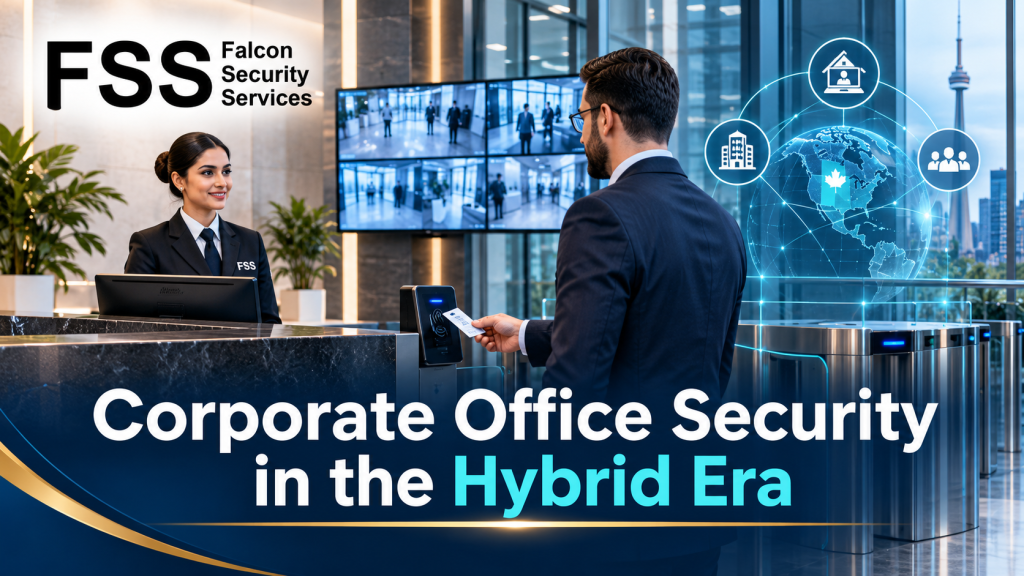
The office security model most buildings still run was designed for a world that no longer exists — one where the same people arrived at the same time, five days a week, and anyone unfamiliar stood out. Hybrid workplace security has to work in a building where Tuesday is packed, Friday is nearly empty, half the faces change week to week, and nobody can say with confidence who is in the building right now. That last point isn’t a minor inconvenience; it breaks things that used to be automatic, including your emergency headcount. Here’s what actually changed and what corporate offices need now. For the wider picture, see our corporate office security services.
What hybrid actually changed
Four shifts matter, and they compound.
Occupancy became unpredictable. Buildings now swing between near-capacity midweek and sparsely occupied on Mondays and Fridays. Security staffed to an average is overstaffed on the quiet days and stretched on the busy ones.
Familiarity disappeared. The old informal control in an office was that people recognized each other. When attendance rotates and teams hot-desk, “I don’t know that person” stops being a signal, because nobody knows most people on any given day.
Empty floors became normal. Whole floors sit unoccupied for days at a time, with equipment, documents, and server rooms still in them. An empty floor in a staffed building attracts less attention than an empty building does.
The visitor mix widened. Clients, contractors, cleaners, food couriers, and employees from other locations now move through buildings in patterns that don’t repeat predictably.
The problem nobody plans for: you don’t know who’s in the building
This is the gap most hybrid security discussions miss. In a fixed-attendance office, a fire alarm triggered a muster and the headcount roughly matched expectations. In a hybrid building, the expected number is unknown — which means nobody can confidently say whether everyone got out.
That makes access data far more important than it used to be, and it has to actually reflect reality. If badges are shared, doors are propped, or people tailgate through a turnstile behind a colleague, your system reports a number that is simply wrong at the moment it matters most. Accurate access records aren’t a bureaucratic nicety in a hybrid building; they’re the basis of your emergency response. This is one of the clearest arguments for a staffed lobby alongside technology — a person at the entry point notices the tailgate that a reader never records.
Tailgating, access, and the new weak points
Access control in a hybrid building faces pressure it wasn’t designed for.
- Tailgating is socially easy. Holding a door for someone carrying a laptop bag feels polite, and in a building where nobody recognizes anybody, it’s rarely challenged.
- Badge data drifts. Departed employees, long-absent staff, and contractors from a finished project often retain credentials far longer than they should.
- After-hours density is thin. Someone working alone on a quiet floor at 8 p.m. is a lone-worker consideration as much as a security one.
- Deliveries reach further in. Courier and food delivery now routinely travels above the lobby, which erodes the old clean boundary between public and secure space.
- Multi-tenant complexity. In a shared tower, base-building security and individual tenant security have different scopes, and the seams between them are where confusion lives.
Technology helps — camera and access systems do real work here — but every one of these weak points ends in a human judgment call about whether someone belongs.
Rethinking coverage for a hybrid building? Book a consultation and we’ll assess it with you.
What good hybrid-era office security looks like
The model that works is lighter than a fortress and more deliberate than a greeter.
- Staffed lobby, matched to the rhythm. A professional presence at the entry point handles visitors, challenges tailgating courteously, and provides the human layer behind the technology. Many buildings now use a concierge-plus-security model — service-forward, but genuinely trained.
- Coverage that flexes with occupancy. Staffing weighted to busy days and busy hours rather than a flat schedule that fits no day well.
- Disciplined visitor management. Pre-registration, verified identity, and a record that’s accurate enough to be useful in an evacuation.
- Credential hygiene. Regular review so access is revoked when people leave and contractor credentials expire with the project.
- After-hours checks. Mobile patrol for empty floors, closed buildings, and parking areas once the lobby closes.
- Trained de-escalation. Office security still handles upset visitors, workplace conflicts, and occasionally a terminated employee returning — situations where calm handling matters far more than physical presence.
Done well, hybrid security is less visible and more effective than the old model: a building that feels open and welcoming on a busy Tuesday, and is genuinely controlled on a quiet Friday.
Frequently Asked Questions
Q1. How did hybrid work change office security?
Ans. Occupancy became unpredictable, staff stopped recognizing each other, whole floors now sit empty on some days, and the visitor mix widened — all of which weakened the informal controls offices used to rely on.
Q2. Why is knowing who’s in the building such a problem now?
Ans. Because in an emergency you need an accurate headcount, and with variable attendance there’s no expected number to check against. Your access records become the only reliable source.
Q3. What is tailgating and why does it matter more now?
Ans. Tailgating is following an authorized person through a controlled door. It matters more because in a hybrid building nobody recognizes everyone, so an unfamiliar face rarely gets challenged.
Q4. Do we still need a staffed lobby if we have access control?
Ans. Usually yes. Technology records credentials; a person notices the tailgate, assesses the visitor, and exercises judgment — which is where most real decisions happen.
Q5. How should security staffing match variable occupancy?
Ans. Weight coverage toward your busiest days and hours rather than applying a flat schedule, and keep lighter but genuine coverage on quiet days when floors sit empty.
Q6. What are the risks of empty floors?
Ans. Equipment, documents, and server rooms remain in place while nobody is present, and an unoccupied floor inside a staffed building draws far less attention than an empty building would.
Q7. How often should access credentials be reviewed?
Ans. Regularly enough that departures and finished contracts are reflected promptly. Credential drift — old badges still active — is one of the most common findings in office security reviews.
Q8. Does office security need de-escalation training?
Ans. Yes. Office incidents typically involve upset visitors, workplace conflict, or a returning terminated employee, where calm, trained handling matters far more than physical presence.
Q9. Who is responsible for security in a multi-tenant tower?
Ans. Base-building security covers common areas and entry points while tenants handle their own suites, so the important thing is defining clearly where one scope ends and the other begins.
Q10. Where should we start improving hybrid office security?
Ans. Start with access accuracy — credential reviews and tailgating — because everything else, including your emergency headcount, depends on knowing who is actually in the building.
Hybrid work didn’t reduce the need for office security; it changed what the job is. Match coverage to real occupancy, keep access records honest, staff the lobby with people who can exercise judgment, and check the spaces nobody occupies. That’s a building that works on its busiest day and its quietest one.
Ready to modernize your office security model? Request a consultation with our corporate team.
One Response