
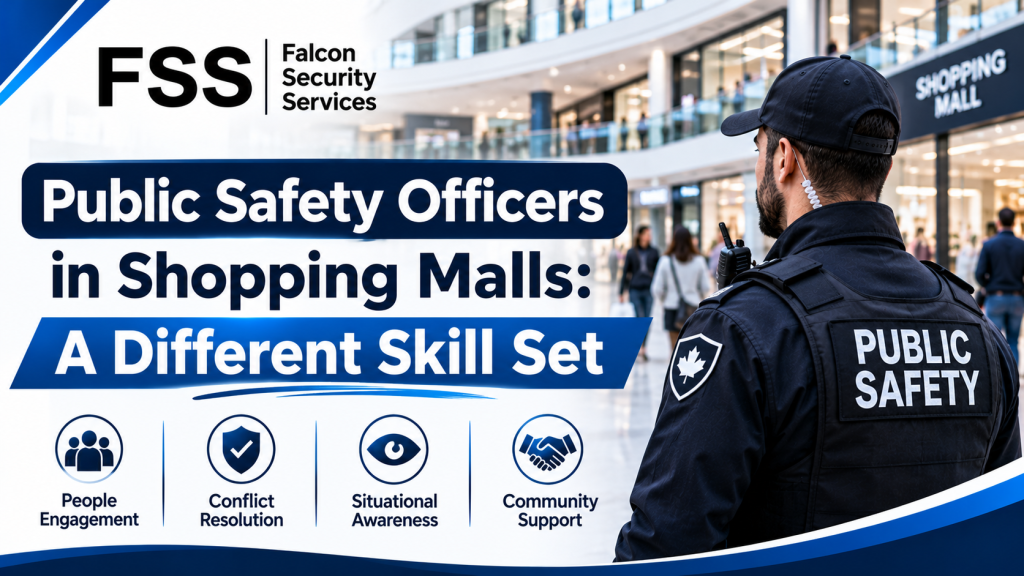
A shopping centre is a strange legal and social creature: private property that functions as public space. Thousands of people who owe you nothing walk through daily — shoppers, teenagers, seniors, families, people with nowhere else to be warm. That reality is why a mall public safety officer does a fundamentally different job than a store security guard or an industrial site officer. The role is closer to community-facing public service than to asset protection, and the skill set reflects it: medical response, lost children, de-escalation, accessibility, and the judgment to know when enforcement is the wrong answer. Here’s what the role actually involves. For the wider picture, see our shopping mall security services.
Why “public safety officer” is the right title
The language matters because it describes the orientation. A store security guard protects one tenant’s merchandise. An industrial officer protects a site from intrusion. A mall officer is responsible for the safety and experience of a large, diverse public in a space they treat as communal — while also protecting the property.
That means most of the work isn’t adversarial at all. On a typical shift, an officer will give directions far more often than they’ll confront anyone. They’ll help a parent who can’t find a child, assist an elderly shopper who has fallen, mediate a dispute between customers, check on someone who seems unwell, and move through the concourse as a visible, approachable presence that makes the centre feel managed.
An officer hired for physical presence alone will do this badly. The role rewards communication, patience, and judgment — which is why it should be recruited and trained as a distinct discipline rather than filled from a general guard roster.
The core competencies
Medical response. Malls see a high volume of medical incidents simply because of foot traffic and demographics — falls, cardiac events, fainting, allergic reactions. First aid and AED training aren’t optional extras for a mall officer; they’re central, and response time in a large concourse depends on officers being positioned and prepared.
Lost children. Every centre needs a defined protocol, and officers must know it cold: securing exits where appropriate, coordinating a search, calming the parent, and handling the reunion safely. These moments are frequent, high-emotion, and heavily scrutinized when handled badly.
De-escalation. Youth group dynamics, intoxicated individuals, disputes between customers, and tenant conflicts all resolve better through communication than authority. Officers who escalate reflexively create incidents the centre then has to answer for.
Mental health and vulnerable-person response. Malls are warm, public, and open to everyone, so officers regularly encounter people in crisis or experiencing homelessness. Trained officers respond with care and connect people to appropriate help rather than simply ejecting them — which is both the humane answer and, usually, the one that avoids a public complaint.
Accessibility. In Ontario, accessibility obligations under the Accessibility for Ontarians with Disabilities Act extend to customer-facing staff, and officers are among the most customer-facing people in the building. Knowing how to assist a shopper with a disability respectfully is part of the job, not an add-on.
Emergency coordination. Evacuations, fire alarms, and severe weather in a building holding thousands of people require officers who know procedures and can direct crowds calmly.
Wondering whether your officers are trained for this role? Book a consultation and we’ll review it.
Authority — and its limits
Mall officers work on private property, which gives the centre real authority and officers a narrow role in exercising it.
In Ontario, the Trespass to Property Act allows an occupier to control who may enter and remain on the premises, and to issue notice to those who aren’t welcome. That’s the mall’s principal tool for dealing with persistent problem behaviour, and it’s exercised through documented, consistent process — not by an officer improvising on the concourse.
What officers should not do is act as enforcement muscle. Physical intervention is a genuine last resort, pursuit through a busy centre is dangerous, and detaining someone carries significant legal exposure if done without proper grounds. The boundary with tenants matters here too, since a theft inside a store is the tenant’s matter rather than the mall’s — a distinction we unpack in our guide to mall security and tenant loss prevention boundaries.
How the role connects to the rest of the property
A public safety officer’s presence inside the concourse is only part of the coverage picture. The same standards should extend to the parking lot, where customers feel most vulnerable, and to after-hours patrol of a closed centre. Mobile patrol typically handles the exterior and overnight window, while concourse officers carry the daytime public-facing load.
When you’re evaluating providers, the question isn’t whether they can supply bodies — it’s whether they recruit and train for this specific discipline, which our property manager’s guide to choosing a mall security vendor covers in detail.
Frequently Asked Questions
Q1. What is a public safety officer in a shopping mall?
Ans. An officer responsible for the safety and experience of the public in a centre’s common areas — handling medical response, lost children, de-escalation, and assistance while also protecting the property.
Q2. How is a mall officer different from a store security guard?
Ans. A store guard protects one tenant’s merchandise inside that store. A mall officer serves a large public across common areas, with far more service and safety work than loss prevention.
Q3. Do mall officers need first aid training?
Ans.Yes. Malls generate a high volume of medical incidents due to foot traffic and demographics, so first aid and AED capability is central to the role rather than optional.
Q4. What should happen when a child goes missing in a mall?
Ans. The centre should have a defined protocol that officers know thoroughly — coordinating the search, managing exits where appropriate, supporting the parent, and handling reunion safely.
Q5. Can mall security remove someone from the property?
Ans. In Ontario, the Trespass to Property Act lets an occupier control who may enter and remain, including issuing notice. It should be exercised through documented, consistent process rather than ad hoc decisions.
Q6. Should mall officers chase a fleeing suspect?
Ans. Generally no. Pursuit through a crowded centre endangers the public, and detaining someone without proper grounds creates serious legal exposure.
Q7. How should officers handle people experiencing homelessness?
Ans. With trained, humane response that connects people to appropriate support where possible. Reflexive ejection tends to create complaints and rarely resolves anything.
Q8. Does accessibility training apply to mall security?
Ans.In Ontario, accessibility obligations extend to customer-facing staff, and officers are among the most customer-facing people in a centre, so knowing how to assist respectfully is part of the role.
Q9. What’s the most common call a mall officer handles?
Ans. Assistance and service — directions, lost property, minor medical issues, and customer questions — far more often than confrontation or theft-related incidents.
Q10. How do we know if our provider trains for this role specifically?
Ans. Ask about first aid and AED certification, lost child protocols, de-escalation and mental health response, and accessibility training. A provider treating malls as generic guarding won’t have specific answers.
Mall security is public-facing work in a space the public treats as its own. Officers who can give directions, respond to a medical emergency, calm a dispute, and exercise authority sparingly make a centre feel safe and welcoming. Officers trained only to confront make it feel neither.
Ready for officers trained for public-facing work? Request a consultation with our retail centre team.