
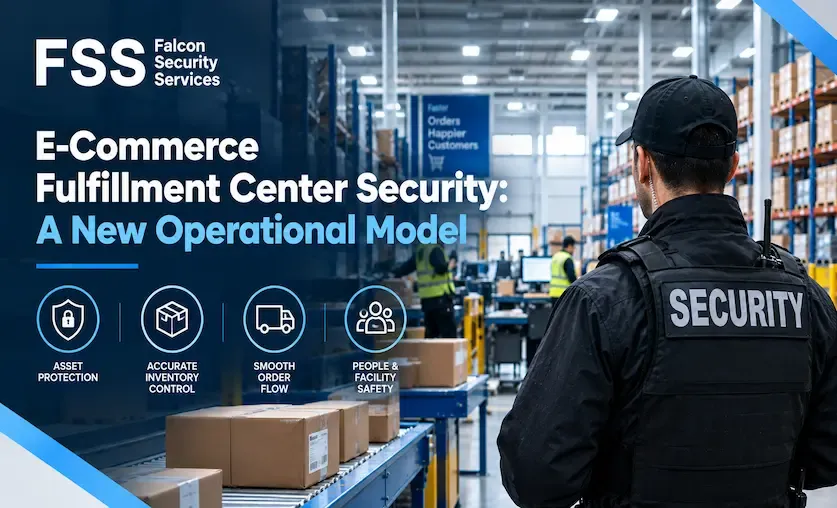
A fulfillment centre isn’t a warehouse with a website attached — it’s a different operating model, and it breaks security plans designed for traditional distribution. E-commerce fulfillment security has to cope with dense, high-value, easily concealed inventory, a workforce that can double overnight for peak, constant parcel movement in both directions, and a building that often never closes. The controls that work for a pallet-in, pallet-out operation don’t map cleanly onto a site picking thousands of individual items an hour. Here’s what actually changes and what a capable security model looks like. For the wider picture, see our warehouse security services.
Why fulfillment is a different security problem
Four structural features make it distinct from classic distribution.
Inventory is small, dense, and valuable. Traditional warehouses move pallets — awkward, visible, hard to walk out with. A fulfillment centre stores consumer goods at item level: electronics, cosmetics, apparel, accessories. Hundreds of dollars of product can disappear into a pocket, and a single tote can hold more resale value than a full pallet of bulk goods.
Velocity hides discrepancies. When a site processes thousands of picks per hour, small losses vanish into normal variance. The signal-to-noise problem is far worse than in a low-velocity operation, which is why internal theft in fulfillment often runs undetected for a long time. In a pallet operation, a missing pallet is obvious; in a fulfillment centre, a missing unit looks like a mis-pick, and mis-picks happen all day long. The noise is the cover.
The workforce scales violently. Peak season can mean a headcount that doubles or triples with temporary labour, hired fast, inducted briefly, and gone in weeks. The access population grows exactly when the inventory on hand is at its highest.
Returns flow backwards. Reverse logistics is a loss channel that pallet-based distribution barely has — and one of the least controlled areas in most fulfillment operations.
Returns processing: the underwatched vector
Returns deserve their own attention because the process is built on trust and runs at speed.
A returns area handles goods arriving without a trusted count, assessed individually, then either restocked, refurbished, liquidated, or written off. Each of those decisions is a judgment call made by one person, often under time pressure. That creates several openings: items recorded as received that never arrived, saleable goods written off as damaged and removed, restocking that never reaches the shelf, and refunds processed against returns that don’t exist.
Controls here look more like process discipline than physical security: separate the person who receives a return from the person who dispositions it, require a second check on high-value write-offs, run exception reporting on disposition patterns by individual, and put the physical returns area under proper camera coverage with a defined review routine rather than passive recording.
Returns also tend to be physically marginal — tucked at the back of the building, staffed thinly, and treated as a cost centre nobody wants to resource. That neglect is exactly what makes it attractive. A simple test: ask who reviewed your returns disposition data last month. If the answer is nobody, you have an unwatched channel where saleable goods are written off by individual judgment every single day.
Peak season: the hardest security window
Peak is when every risk factor peaks together — maximum inventory, maximum headcount, minimum familiarity, maximum time pressure, and often extended or round-the-clock shifts.
The failure mode is predictable: under hiring pressure, induction gets compressed, badges get issued broadly “to keep things moving,” and supervision thins out across more people. The result is the largest access population of the year with the weakest controls of the year.
Operations that handle peak well plan it months ahead. They induct every temp to the same standard as a permanent hire, keep zone-based access rather than issuing universal badges, concentrate supervision where the risk is (pick faces, returns, the dock), and scale on-site security with headcount rather than leaving it flat while the workforce triples.
Scaling for peak and worried about your controls? Book a consultation and we’ll plan it with you.
Building a security model that fits
Fulfillment security works best as layers matched to how the building actually operates:
- Controlled entry and exit for people. Where goods are small and concealable, the personnel exit process matters more than in pallet operations — and it must be applied consistently, to everyone, to be both fair and defensible.
- Zone-based access. High-value storage, returns, and staging shouldn’t be open to every badge in the building.
- Monitored camera coverage with real review. Cameras over pick modules, returns, and dock doors deliver value only when someone watches and reviews rather than archives — the integration point covered across our coverage models guide.
- Exception reporting tied to people. Discrepancies linked to individuals, shifts, or stations surface what cameras can’t.
- Dock and yard discipline. Parcel volume means constant carrier movement, so driver verification and trailer yard controls stay essential.
- 24/7 coverage that matches the operation. If the building never closes, security that works business hours is covering the wrong window.
One caution worth stating plainly: automation doesn’t reduce the need for people. Robotic storage and conveyor systems change where humans work, not whether security is needed — and they add new concerns, like controlled access to automation zones and ensuring officers understand the safety rules of those areas.
Frequently Asked Questions
Q1. How is fulfillment centre security different from warehouse security?
Ans. Inventory is item-level, dense, and easily concealed; velocity hides discrepancies; the workforce scales dramatically at peak; and returns create a reverse flow that pallet operations barely have.
Q2. Why is returns processing a security risk?
Ans. Because goods arrive without a trusted count and one person often both receives and dispositions them. That allows false receipts, improper write-offs, and restocking that never happens.
Q3. What’s the biggest risk during peak season?
Ans. The largest access population of the year combined with the weakest controls — compressed induction, broadly issued badges, and supervision stretched across many unfamiliar temps.
Q4. Should temporary staff get the same induction as permanent employees?
Ans. Yes. Temps work the same inventory with the same access, so compressing their induction simply creates your biggest exposure at your busiest time.
Q5. How do we detect theft when volumes are so high?
Ans. Through exception reporting that ties discrepancies to individuals, shifts, and stations, combined with targeted counts on high-value SKUs. Raw volume defeats manual observation alone.
Q6. Are exit checks appropriate in a fulfillment centre?
Ans. Many operations use them where goods are small and concealable. The key is applying the process consistently to everyone and operating it within employment and privacy obligations.
Q7. Does automation reduce security requirements?
Ans. No. It changes where people work and adds controlled automation zones, but it doesn’t remove the need for access control, monitoring, and response.
Q8. What areas need the most camera coverage?
Ans. Pick modules, returns processing, high-value storage, staging, and dock doors — with a defined review routine rather than passive recording.
Q9. Does a 24/7 operation need 24/7 security?
Ans. If the building runs continuously, coverage should match it. Security scheduled to business hours leaves the quietest, least supervised shifts unprotected.
Q10. Where should we start if our controls feel behind?
Ans. Start with returns and peak staffing — they’re consistently the weakest points — then verify access zoning and whether anyone is actually reviewing your camera footage.
- Fulfillment centres concentrate value, people, and speed in a way traditional distribution never did. Match your controls to that reality — tighten returns, hold your standards through peak, zone your access, and review what your cameras see — and the model’s speed stops being a cover for loss.
- Ready to secure a fulfillment operation properly? Request a consultation with our warehouse team.