
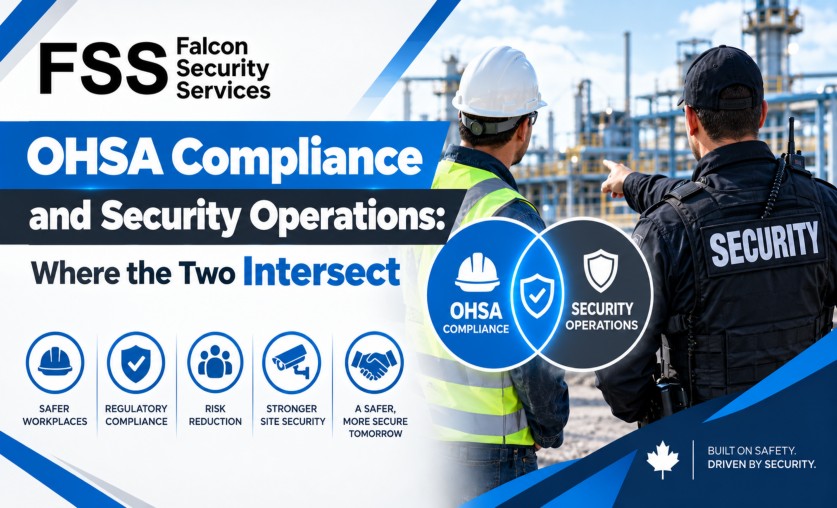
Most plant managers think of security and health-and-safety as separate files — one protects assets, the other keeps people safe and the Ministry satisfied. In practice they overlap constantly. OHSA security operations in Canada sit inside your safety system, not beside it: your officers are workers with rights and duties under the Act, they’re often your only eyes on site after hours, and they’re frequently first on scene when something goes badly wrong. Getting that intersection right strengthens your compliance position; getting it wrong quietly weakens it. Here’s where the two actually meet. For the wider picture, see our industrial security services.
The Internal Responsibility System includes your security officers
Ontario’s Occupational Health and Safety Act is built around the Internal Responsibility System (IRS) — the principle that everyone in the workplace has a role in keeping it safe, with duties distributed across employers, supervisors, and workers.
Contracted security officers are inside that system. They’re workers of their provider, they’re present in your workplace, and the same logic applies to them as to anyone else on site. Under the IRS, a worker who sees a hazard or a contravention has a statutory duty to report it, and the employer or supervisor must then act on it.
That has a practical consequence most sites underuse: your overnight officer walking the plant is a hazard-reporting channel operating when your safety team is at home. A blocked exit, a leaking drum, an unguarded opening, a failed light over a walkway — all of it can be captured and escalated hours before the day shift arrives, if the officer is trained to notice and your process is set up to receive it.
Employer duties that touch security directly
Under the OHSA, employers must provide information, instruction, and supervision to protect workers, appoint competent supervisors, and — under the general duty clause — take every precaution reasonable in the circumstances for a worker’s protection. That last clause is deliberately broad: if a hazard exists and a reasonable precaution would address it, you’re expected to act whether or not a specific regulation names it.
Several of those precautions are delivered through security:
- Controlled access keeps untrained people out of hazardous areas — a safety control as much as a security one.
- Contractor and visitor management ensures people entering your site are logged, inducted, and accounted for in an evacuation.
- Workplace violence obligations apply at industrial sites too, and a trained security presence is part of how many employers meet the duty to provide a means of summoning immediate assistance.
- Emergency response support — officers who know evacuation procedures, muster points, and escalation paths.
- Hazard awareness, which is why WHMIS training for officers isn’t a nice-to-have on a site with hazardous products.
Want your security coverage aligned with your OHSA obligations? Book a consultation and we’ll map it with you.
Security officers have OHSA rights too — including refusal
This is the part sites forget. Officers working at your facility hold the same core worker rights: the right to know about hazards, the right to participate in health and safety, and the right to refuse work they believe is unsafe.
A security officer can refuse unsafe work. If you’re asking an officer to patrol an area with an uncontrolled hazard, work alone in conditions your own staff wouldn’t accept, or enter a space they aren’t trained or equipped for, that’s a live issue — not a service complaint. Lone-worker considerations matter especially here, since overnight officers are frequently the only person on a large site, and check-in procedures and a reliable way to summon help are basic requirements rather than extras. This is one reason after-hours coverage should be designed with safety in mind, not just deterrence.
The critical injury scene — the duty most sites overlook
Here’s the intersection that matters most and gets least attention. If a person is killed or critically injured at your workplace, the OHSA requires notification and, importantly, that the scene not be disturbed except for specific permitted purposes — saving life or relieving suffering, maintaining an essential public utility or public transportation system, or preventing unnecessary damage — until an inspector permits otherwise.
Your overnight security officer may be the first person to arrive at that scene. If they don’t know this duty, well-intentioned tidying up can compromise an investigation and put the employer in breach. A properly trained industrial officer knows to secure the area, control access, notify immediately, document what they observed, and change nothing.
That single piece of knowledge is a fair test of whether a provider genuinely understands industrial work. It belongs in your evaluation — see our questions to ask before hiring an industrial security provider — and it should be reflected in the risk picture your site risk assessment produces.
Frequently Asked Questions
Q1. Does the OHSA apply to contracted security guards on our site?
Ans. Yes. They’re workers under the Act, employed by their provider and present in your workplace, so OHSA duties and rights apply to them as they do to anyone else on site.
Q2. What is the Internal Responsibility System?
Ans. It’s the principle underpinning the OHSA that everyone in a workplace — employers, supervisors, and workers — shares responsibility for health and safety, with interlocking duties set out in the Act.
Q3. Can a security guard refuse unsafe work?
Ans. Yes. Security officers hold the same right to refuse work they believe is unsafe as other workers, which is why patrol routes and lone-working arrangements need to be genuinely safe.
Q4. Are security officers required to report hazards they see?
Ans. Under the IRS, a worker who becomes aware of a hazard or contravention has a duty to report it. A well-run security operation turns that duty into a documented after-hours reporting channel.
Q5. What is the “every precaution reasonable” duty?
Ans. It’s the OHSA’s general duty clause requiring employers to take every precaution reasonable in the circumstances to protect workers, even where no specific regulation addresses the hazard.
Q6. What should security do if someone is critically injured on site?
Ans. Secure the area, control access, notify immediately, document observations, and disturb nothing. The OHSA restricts disturbing the scene until an inspector permits it, apart from specific permitted purposes.
Q7. Do workplace violence obligations apply at industrial sites?
Ans. Yes. Violence and harassment duties apply across Ontario workplaces, and trained security presence is one way employers deliver measures like summoning immediate assistance.
Q8. What are lone worker considerations for overnight officers?
Ans. An officer alone on a large site needs defined check-in procedures, reliable communication, and a dependable way to summon help — arrangements that should be designed in, not assumed.
Q9. Does hiring a security provider transfer our OHSA responsibilities?
Ans. No. As the site operator you retain your duties. A capable provider helps you deliver them, but accountability doesn’t move with the contract.
Q10. Do these rules apply outside Ontario?
Ans. The principles are similar across Canada, but each province and territory has its own occupational health and safety legislation, and federally regulated sites fall under the Canada Labour Code.
Security and safety aren’t parallel tracks on an industrial site — they run through each other. Officers who understand the IRS, report hazards, know their own rights, and handle a serious incident correctly make your compliance position stronger. Officers who don’t quietly make it weaker.
Want a security partner that understands your OHSA obligations? Request a consultation with our industrial team.